You know what’s funny about coming to retro gaming late? I missed all the “you had to be there” moments that define most people’s gaming memories. Like, I never experienced the cultural earthquake of certain games hitting at exactly the right time. But sometimes I stumble across something that makes me wish I’d been paying attention back then, and the Beavis and Butt-Head game for Genesis is definitely one of those titles.
Found this one completely by accident at a local game shop about three years ago. The guy behind the counter—probably in his forties, looked like he’d been collecting since the dawn of time—saw me eyeing it and just shook his head. “That’s a weird one,” he said. “Most people either love it or think it’s complete garbage.” Well, hell, that’s exactly the kind of recommendation that gets my attention. Paid probably more than I should have for it, but sometimes you’ve got to take a gamble on the weird stuff.
First thing that hit me when I fired it up was how perfectly it captured this very specific moment in 90s culture that I’d only heard about secondhand. See, I was too busy working construction and trying to keep my first marriage together to pay much attention to MTV in the mid-90s. But my daughter’s always going on about how different things were back then—when MTV actually played music videos and had shows that pushed boundaries just because they could. This game felt like stepping into that world for the first time.
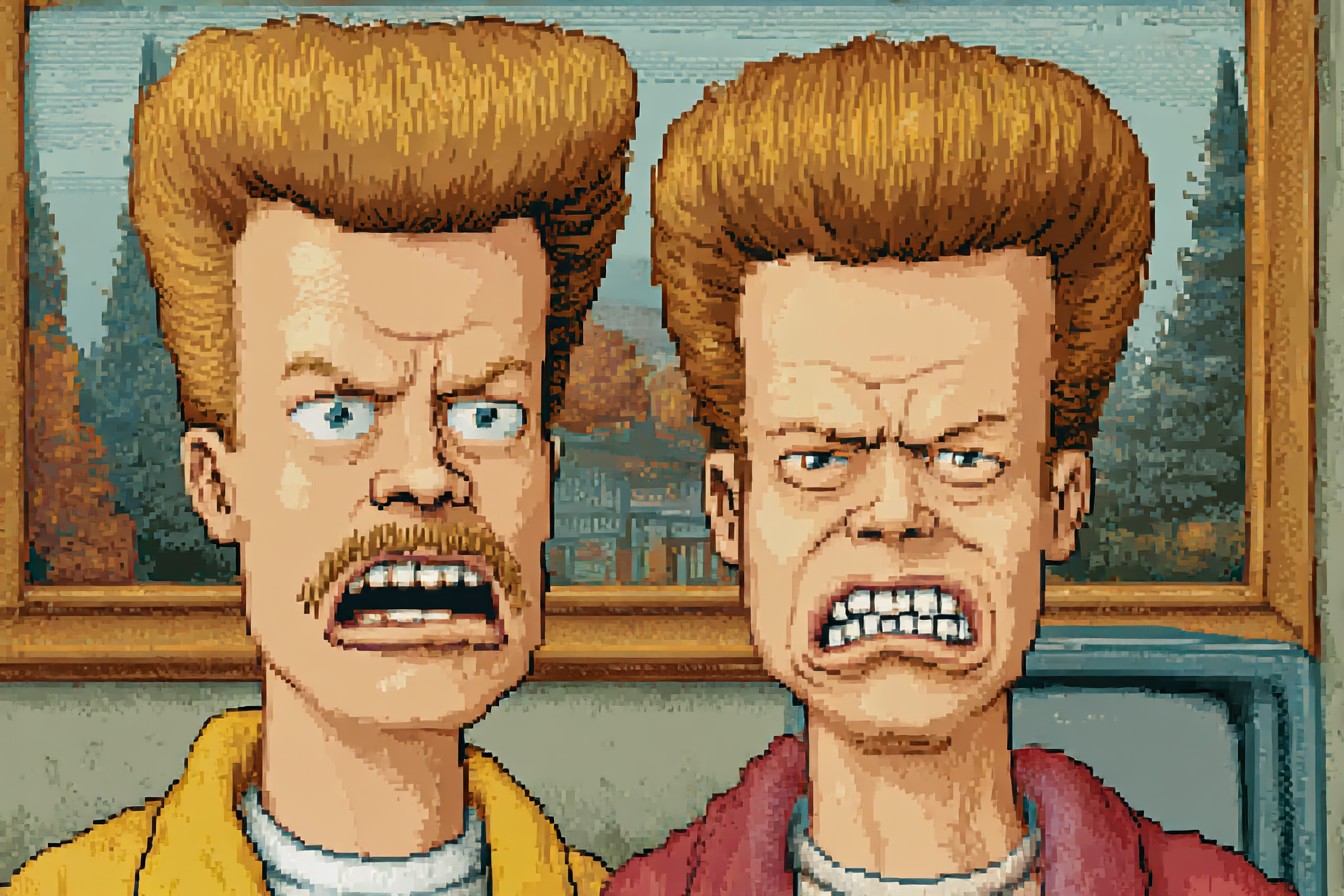
The whole thing is basically an interactive episode of the show, which sounds like a recipe for disaster but somehow works. You’re wandering around Highland, their fictional hometown, causing trouble and completing these bizarre tasks that perfectly capture teenage stupidity. The pixel art has this chunky Genesis charm that I’ve grown to appreciate—bold colors, exaggerated character sprites, everything slightly off-model in that way licensed games always seemed to manage. But instead of feeling cheap, it actually enhances the whole experience.
What really impressed me was the voice work. I mean, the Genesis wasn’t exactly known for crystal-clear audio, but they managed to cram in what sounds like actual dialogue from the show. Every “heh heh” and “fire, fire!” comes through surprisingly well, even with all the typical Yamaha FM synthesis competing for space. It’s like they actually gave a damn about making it feel authentic instead of just slapping the license on some generic platformer and calling it a day.
The mini-games are where this thing really shines, though. There’s this sequence where you’re supposed to help them disrupt a school assembly—timing button presses to maximize chaos while avoiding the principal. Another has you working at Burger World, except the goal is to be as incompetent as possible while technically still doing your job. It’s like they bottled the essence of teenage rebellion and made it playable, which is way more clever than it has any right to be.
I spent way too many evenings just exploring Highland, soaking up all the little details. Street signs with ridiculous names, background characters that look suspiciously like other MTV personalities, shops selling products that are obvious parodies of real brands. The developers clearly watched the show obsessively and packed in references that reward fans without alienating newcomers. Coming to it fresh, without nostalgia coloring my judgment, I could appreciate how much thought went into recreating that world.
The timing of this release was apparently perfect—1994, right when alternative culture was hitting mainstream but hadn’t lost its edge yet. MTV still played actual music videos, and shows like Beavis and Butt-Head could get away with commentary that would probably get them cancelled seventeen different ways today. The game caught that exact moment when crude humor felt revolutionary rather than just… well, crude. I missed experiencing that cultural shift firsthand, but playing this gave me a glimpse of what that felt like.
Gameplay-wise, it’s not exactly revolutionary. Point-and-click adventure elements mixed with arcade mini-games wasn’t breaking new ground even in ’94. But the writing… man, the writing is spot-on. Every piece of dialogue feels like it could’ve been lifted straight from the show, and they managed to work in references to contemporary music and pop culture without making it feel forced. That’s harder to pull off than it sounds, especially in a licensed game.
The music deserves mention too. Instead of trying to recreate the show’s soundtrack, they went with these fantastic chiptune interpretations of various rock and metal tracks. The Genesis sound chip handled it brilliantly—all that metallic crunch and bass that made the system so distinctive. It was like hearing familiar songs filtered through a video game lens, and it worked way better than it should have.
Playing it now feels like opening a time capsule from a very specific moment in pop culture. The humor that seemed so edgy and transgressive back then feels almost quaint compared to modern entertainment. But there’s something genuinely charming about that innocence—the idea that two animated teenagers making fun of music videos could feel like the height of cultural rebellion. That’s a level of optimism about offending people that just doesn’t exist anymore.
The game wasn’t perfect, hell, it wasn’t even particularly good by traditional standards. But it was authentic in a way most licensed games completely fail to achieve. It understood its source material, respected what made it work, and translated that into something playable without losing the essence. In our current era of focus-grouped, committee-designed entertainment, that kind of creative honesty feels revolutionary.
What strikes me most is how this represents a whole cultural ecosystem that’s basically vanished. Afternoon TV blocks, music video culture, that specific type of irreverence that defined mid-90s youth culture—none of that really exists anymore. Coming to this game as an outsider, without the nostalgia filter, I can see how special that moment was. It wasn’t just about the crude humor or the boundary-pushing content. It was about a time when popular culture felt more… I don’t know, spontaneous? Less calculated?
Sometimes I wonder if my daughter realizes how good she had it, growing up during the tail end of that era. She’s always telling me about shows and games from the late 90s and early 2000s that pushed boundaries just because they could, before everything got sanitized and corporate-approved. This Beavis and Butt-Head game is like a perfect artifact from that time—crude, clever, completely committed to its own stupidity in the best possible way.
Is it worth tracking down today? If you can find a reasonably priced copy and you’re curious about 90s culture, absolutely. If you’re looking for tight gameplay mechanics and cutting-edge design, maybe look elsewhere. But if you want to experience a piece of interactive 90s weirdness that somehow managed to be both completely juvenile and surprisingly smart, this is your game. Just don’t expect to explain to your friends why you spent forty bucks on a Beavis and Butt-Head cartridge. Some things are worth the weird looks.

Timothy discovered retro gaming at forty and never looked back. A construction foreman by day and collector by night, he writes from a fresh, nostalgia-free angle—exploring classic games with adult curiosity, honest takes, and zero childhood bias.