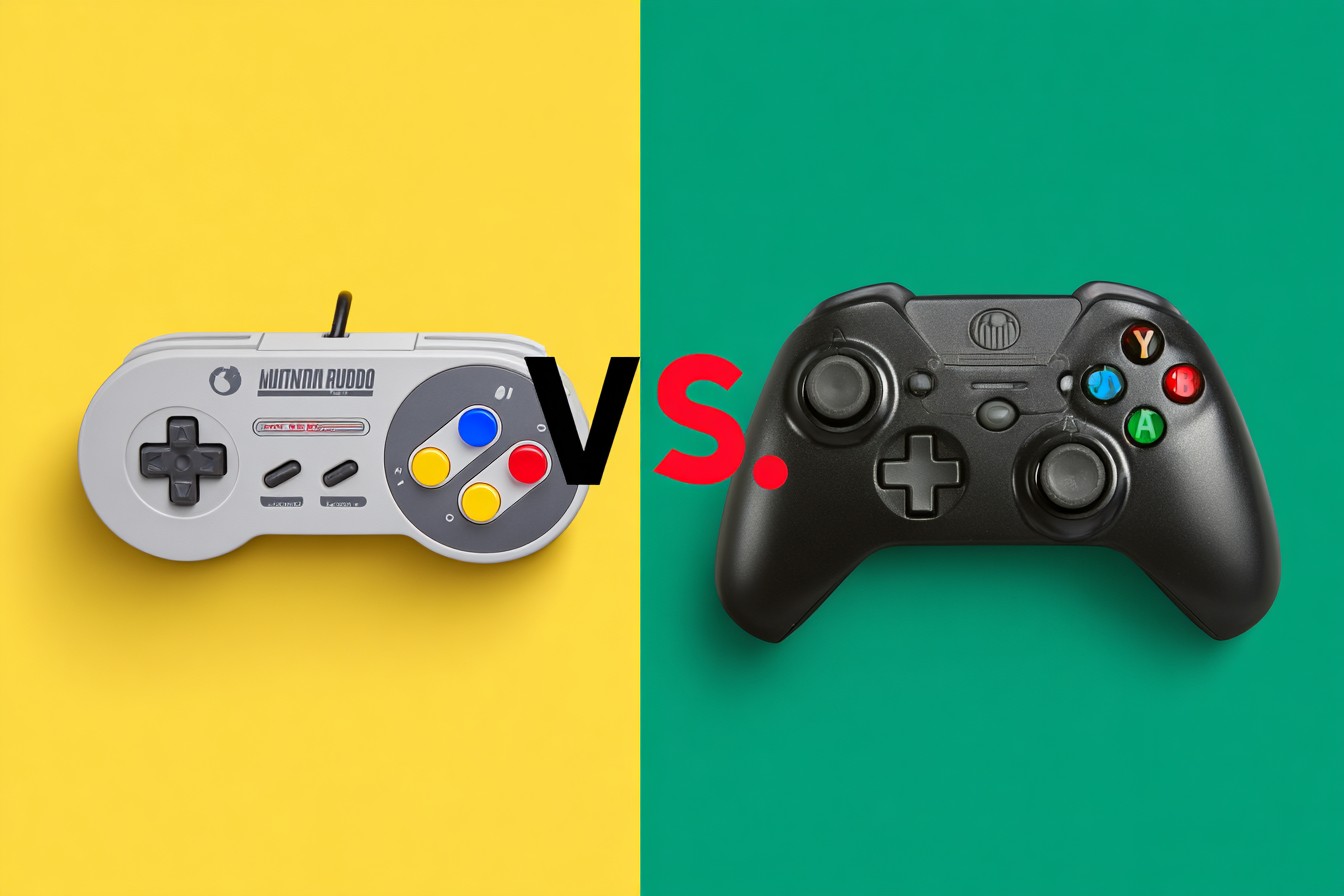
I’ve been analyzing gaming hardware since the 1980s, which means I’ve held every controller generation from the original NES pad through modern ergonomic marvels. The question of whether original controllers or modern alternatives are better for retro gaming isn’t simple because it depends on what you’re playing and what matters to you. Some games were designed specifically for their original controllers and simply play better with authentic hardware. Other games work equally well or better with modern controllers that have improved ergonomics and build quality.
The original controllers had genuine design compromises that were accepted at the time because alternatives didn’t exist. The NES pad was revolutionary for 1983 but the D-pad caused hand fatigue in long sessions. The SNES controller introduced shoulder buttons and improved ergonomics but was still designed for hands that were smaller than modern adult hands. The Mega Drive controller felt better ergonomically but the button layout confused players coming from SNES. The original PlayStation pad didn’t have analog sticks until the DualShock revision, which changed how games had to be designed.
But here’s the crucial distinction – playing retro games with original controllers is about authenticity and understanding how games were actually designed. Playing them with modern controllers is about comfort and accessibility. The question of which is “better” depends entirely on whether you’re prioritizing authenticity or practicality.
Why Original Controllers Matter
Original controllers matter because games were designed with specific hardware in mind. Fighting game input sequences were designed around the SNES controller’s button layout. The six buttons became standard for fighting games because Street Fighter II needed them and the SNES pad provided them in an arrangement that made sense for the game. Playing Street Fighter II on an original SNES controller feels natural because the button placement matches the game’s design. The same game on a modern controller with different button spacing feels slightly off because your muscle memory doesn’t match the controller design.
The Mega Drive controller’s three-button layout created a different fighting game experience. The SNES had six buttons in two rows. The Genesis had three buttons in a row. Games designed for each system optimized around those layouts. Sonic the Hedgehog’s controls were designed around the Genesis controller’s button placement. The game feels right on original hardware and slightly awkward on controllers with different spacing.
Arcade stick players understand this intimately. The arcade stick layout became the standard because Street Fighter II arcade cabinets used that layout. When players adapted arcade sticks for home console use, they wanted the spacing and button arrangement to match what they’d practiced on in arcades. The fighting game community became obsessed with controller fidelity because they understood that muscle memory matters in competitive play.
The D-pad is the most analyzed controller element in retro gaming circles. The original NES D-pad was a single molded piece that wasn’t ergonomically ideal. Your thumb would move across it awkwardly for diagonal inputs. The SNES improved this with a more sophisticated D-pad design that felt better. The Mega Drive had a different D-pad that some players preferred. Modern controllers often have entirely different D-pad designs that change how the controller feels for games designed around classic D-pads.
The original PlayStation controller revolutionized gaming by introducing analog sticks, but the original version didn’t have sticks – it was a basic cross-pad controller. The DualShock revision added vibration feedback and analog sticks. Games designed for the original controller worked differently than games designed for DualShock. Ape Escape was one of the first games truly designed around analog stick control. Playing it on the original controller is impossible because the game demands analog stick input.
Why Modern Controllers Matter
But original controllers had genuine problems that modern controllers solve. The NES controller’s hard edges caused hand fatigue. The buttons required more pressure than modern controllers. The cord was short. Playing through an entire game session caused hand pain that modern controllers eliminate. For someone wanting to play retro games without physical discomfort, modern controllers are objectively better.
Modern ergonomic controllers are designed around human hands. They’re curved to fit your palms. The buttons require less pressure. The triggers are smooth. The sticks have realistic resistance. If you’re playing a 20-hour RPG, modern controllers make that feasible without pain. Original controllers make extended play sessions genuinely uncomfortable.
Build quality is genuinely better on modern controllers. Original controllers often have stick drift now – the analog sticks have degraded after decades of use. Original controllers sometimes have broken buttons or unresponsive D-pads. Modern controllers have better build quality that will last longer. If you’re buying a controller expecting to play hundreds of hours, modern options are more practical.
The wireless connectivity of modern controllers is genuinely convenient. Original controllers had short cords or required wireless adapters. Modern controllers connect wirelessly natively. You can sit back and play without being tethered to your console. This is a legitimate convenience advantage that shouldn’t be dismissed as unimportant.
Cross-platform compatibility matters for some players. If you want to use the same controller for retro games on your TV and modern games on your PC, modern controllers support that. Original controllers require adapter hardware. Modern controllers like the 8BitDo wireless controllers work across multiple systems natively.
The Technical Differences That Matter
The button actuation matters more than casual players realize. Original controllers used rubber dome switches under the buttons. Modern controllers use mechanical switches with different actuation points and feedback. Rubber dome switches require more pressure. Mechanical switches actuate faster. For fighting games where frame-perfect input matters, this difference is measurable. Professional fighting game players often prefer original controllers or premium modern controllers with arcade-quality switches because the actuation point matters.
The analog stick design is completely different between generations. Original PlayStation analog sticks had a specific resistance and movement range. Modern controllers have different resistance curves. Games designed for original sticks sometimes feel wrong on modern controllers because the acceleration curve is different. Moving the stick on an original controller has a specific feel. Moving it on a modern controller feels different even though the input range is the same.
The D-pad is where technical differences are most obvious. Original controllers had specific D-pad resistance and movement range. Modern controllers often have mushroom-style D-pads that feel completely different. Some modern controllers have separate directional buttons that feel even more different. Playing a game designed around the original D-pad on a modern D-pad reveals how much the original hardware design mattered.
Haptic feedback is something original controllers didn’t have. Modern controllers can provide rumble and vibration feedback. Some games were designed to use the original controller’s limitations to create specific experiences. Adding rumble to those games changes the experience. Whether that’s better or worse depends on whether you value authenticity or enhancement.
Which Should You Actually Use?
The honest answer is it depends on what you’re playing and what matters to you. If you’re playing fighting games competitively or seriously, original controllers or high-quality modern arcade-style controllers are worth considering because muscle memory and input precision matter. If you’re playing story-driven RPGs or action games casually, modern controllers are more comfortable for extended play.
If you’re trying to experience games as they were originally designed, original controllers matter. Playing Street Fighter II on the original SNES controller teaches you something about how the game was designed that playing it on a modern controller doesn’t. Your hands will hurt, but you’ll understand the design.
If you’re playing retro games as entertainment rather than historical preservation, modern controllers are more practical. You can play longer, your hands won’t hurt, and the build quality is better. The games will be fundamentally the same experience.
The 8BitDo controllers offer a middle ground – they’re modern controllers designed to replicate original controller layouts. They have modern ergonomics and build quality but original button spacing. They work across multiple systems. For many players, these represent the best compromise between authenticity and practicality.
Some collectors only use original controllers because they’re preserving the historical experience. Some players only use modern controllers because they’re not interested in hand pain. Most players should probably have both available and choose based on what they’re playing. Competitive players might need specific controllers. Casual players might be fine with anything.
The Honest Assessment
Original controllers matter because they represent how games were designed. They’re historically significant. They teach you something about game design that modern controllers don’t. But they also have genuine drawbacks – ergonomic problems, durability issues, build quality that’s degraded over decades.
Modern controllers matter because they’re practical and comfortable. They have better build quality. They have more features. They work across platforms. They make extended play sessions feasible. But they might not feel exactly right for games designed for specific hardware.
The best approach is having access to both. Play retro games with original controllers occasionally to understand the authentic experience. Play them with modern controllers regularly for practical long-term engagement. Neither is objectively better – they serve different purposes.
If you’re buying controllers for retro gaming right now, consider what you’ll actually be playing. If it’s fighting games and you want authenticity, original controllers or high-quality arcade-style modern controllers matter. If it’s everything else and you want comfort, modern ergonomic controllers make sense. If you want the best of both worlds, 8BitDo controllers offer original layouts with modern quality.
The actual answer that matters is whichever controller lets you enjoy retro games without frustration. If original controllers hurt your hands, modern alternatives are objectively better for your experience. If original controllers feel essential to authenticity, they’re worth the hand fatigue. There’s no single correct answer – just the answer that works for how you actually want to play.

Samuel’s been gaming since the Atari 2600 and still thinks 16-bit was the golden age. Between accounting gigs and parenting teens, he keeps the CRTs humming in his Minneapolis basement, writing about cartridge quirks, console wars, and why pixel art never stopped being beautiful.