The smell hits you first. That mixture of pizza grease, carpet that's seen better decades, and something electrical—maybe ozone from all those CRT monitors running hot. I can close my eyes right now and I'm thirteen again, standing in front of Street Fighter II at Luigi's Pizza Palace, watching some older kid chain combos like he's conducting an orchestra of violence.
You know what's funny? I spent more money in arcades than I ever did on actual games. Mum would give me a fiver for the weekend, and I'd change it into 50p pieces at the counter like I was converting currency for a foreign country. Which, honestly, it kind of was. The arcade was this strange nation where skill actually mattered more than how much your parents earned, where a kid with quick reflexes could hold a machine for twenty minutes on a single credit while a queue formed behind him like he was some sort of digital prophet.
My local arcade was wedged between a Woolworth's and a newsagent that sold imported sweets at criminal prices. The place was called "Galaxy Games"—cheesy name, incredible lineup. They had everything: OutRun with the proper seat that moved when you took corners too fast, Double Dragon with joysticks that clicked just right, and this mental four-player Gauntlet machine that ate friendships for breakfast. "Blue Elf needs food badly!" became our battle cry, shouted across the floor whenever someone was running low on health.
The social hierarchy was brutal and beautiful. There were the button mashers—usually younger kids who'd hammer every control like they were trying to crack walnuts. Then the weekend warriors, older teenagers who'd studied move lists like scripture and could pull off dragon punches with their eyes closed. And at the very top, the arcade gods—guys who seemed to live there, who knew the exact frame data for every character and could make a single quarter last until closing time.
I wasn't a god. Not even close. But I had my moments.

There was this one Saturday—must've been summer '91 because I remember sweating through my Teenage Mutant Ninja Turtles t-shirt—when I finally cracked the code on Golden Axe. Not the gameplay, mind you. The actual social code. See, there was this unwritten rule about co-op games: you didn't just jump into someone else's session unless they were clearly struggling or they gave you the nod. But Golden Axe was different. It practically begged for cooperation, especially when you hit those later levels where the screen filled with enemies like angry confetti.
I'd been watching this older kid—must've been sixteen, seventeen—work his way through as the barbarian, and he was good. Really good. But around stage five, you could see him getting overwhelmed. The little blue thieves were everywhere, stealing his magic potions, and his health was dropping fast. So I stepped up, dropped my 50p, and started playing as the dwarf.
No words exchanged. Just this instant understanding. He'd handle the big guys, I'd deal with the annoying little ones. When one of us was in trouble, the other would bail them out. We played for maybe forty-five minutes, all the way to the end, sharing magic potions and high-fives when we pulled off particularly brutal combo attacks.
That's when I understood what arcade culture really was. It wasn't about the games—well, not just about the games. It was about these temporary tribes that formed around a particular machine, these micro-communities that existed for the length of a session and then dissolved back into the crowd. You'd share strategies with complete strangers, cheer for someone else's high score attempt, and learn the hard way that some people had very strong opinions about whether Ryu or Ken was the superior character.
The pizza place arcade was different from Galaxy Games, though. Smaller, more intimate. They only had maybe eight machines, but they were quality picks. Street Fighter II, obviously—that was non-negotiable by 1992. Mortal Kombat showed up later, complete with the blood code that we'd whisper to each other like it was classified information. "A-B-A-C-A-B-B." Still remember it perfectly.
But the real star was this beat-up OutRun cabinet tucked in the corner. The steering wheel was slightly loose, the brake pedal stuck sometimes, and the monitor had this thin green line running down one side that everyone just accepted as part of the experience. Still the best racing game I'd ever played. Something about threading that Ferrari through traffic while "Magical Sound Shower" played at volumes that definitely violated noise ordinances… it was pure joy translated into quarters and pixels.
I learned so much about life from those arcade sessions. Patience, mostly—waiting your turn while someone else played through their credits. But also this weird form of performance anxiety. There's nothing quite like the pressure of having four people watching you attempt a perfect run on Pac-Man, coins lined up on the control panel like little metal soldiers marking their place in line.
The worst was when you'd built up a reputation on a particular machine and then completely choked during your big moment. I remember one evening, I'd been absolutely destroying everyone on Street Fighter II. Must've won twelve matches in a row, this perfect streak where everything clicked. Hadokens were flowing like water, dragon punches were landing precisely, and I felt invincible.
Then this quiet kid, maybe twelve years old, puts his money up. Picks Blanka. I'm thinking, "Easy win." Wrong. So incredibly wrong. He unleashed this lightning attack combo that I didn't even know existed, stunlocked me into oblivion, and took me down in about thirty seconds. The crowd erupted. I slunk away to console myself with a slice of pepperoni and try to figure out where my confidence had gone.
That's the thing about arcade culture—it kept you humble. Home consoles were forgiving; you could pause, restart, practice in private. But the arcade was live performance every single time. Your mistakes were public, your victories were witnessed, and your quarter was gone whether you lasted thirty seconds or thirty minutes.
The sounds, though. That's what really stuck with me. Every machine had its own audio signature. Street Fighter II had those satisfying punch impacts and Ryu's kiai shouts. Mortal Kombat brought that distinctive "toasty!" whenever someone pulled off an uppercut. The Simpsons arcade game was just pure chaos—Homer's "D'oh!" mixed with cartoon sound effects and eight-bit mayhem.
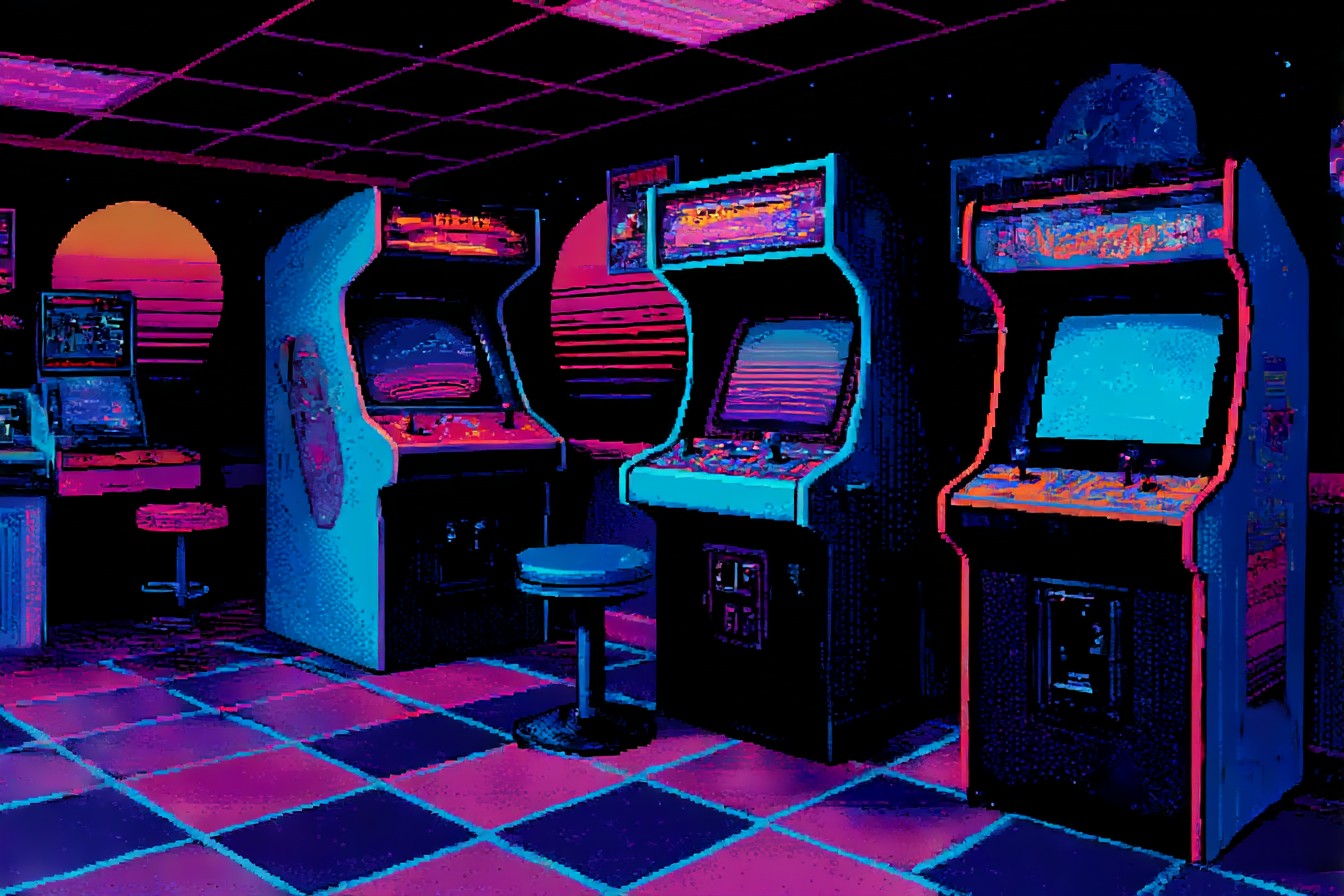
And underneath it all, this constant electronic symphony. Attract mode music looping endlessly, trying to lure you over with promises of high scores and glory. The mechanical sounds of joysticks clicking, buttons being hammered, coins dropping into slots. Even the air hockey table in the corner contributed its own percussion section every time someone scored a goal.
Looking back now, I realize those arcade experiences shaped how I think about games entirely. They taught me that gaming could be social, competitive, collaborative. That skill mattered, but so did sportsmanship. That sometimes the best gaming moments happen when you're not even playing—just watching someone else attempt something incredible and either succeeding spectacularly or failing in ways that make everyone laugh.
The culture died gradually, then suddenly. Home consoles got better, arcade games got more expensive, and kids found other places to spend their pocket money. Galaxy Games became a mobile phone shop. Luigi's Pizza Palace kept their machines for a few more years, but they were mostly gathering dust by the mid-'90s.
But man, for those few golden years, arcades were magic. Pure, quarter-operated magic that taught an entire generation how to game, how to compete, and how to lose gracefully. Sometimes I fire up MAME just to hear those old attract mode tunes again, and I'm right back there, thirteen years old with sticky fingers from pizza and dreams of digital glory.