Man, the smell. I can still conjure it up perfectly – that weird cocktail of cheap pizza grease, cigarette smoke from the adult section, and that distinctive electrical tang from CRT monitors running hot all day long. Walk into Tony’s Pizza & Games on a Saturday afternoon in 1987 and you’d hit that wall of sensory overload that meant one thing: you were about to blow your entire allowance in the next two hours.
My mom would drop me off with a crumpled five-dollar bill and strict orders to “stay out of trouble and don’t talk to strangers,” which was basically impossible when you’re standing next to some high school kid trying to teach you the fireball motion in Street Fighter. Five bucks sounds like nothing now, but back then? That was twenty quarters of pure possibility, assuming I didn’t cave and actually buy a slice of pizza.
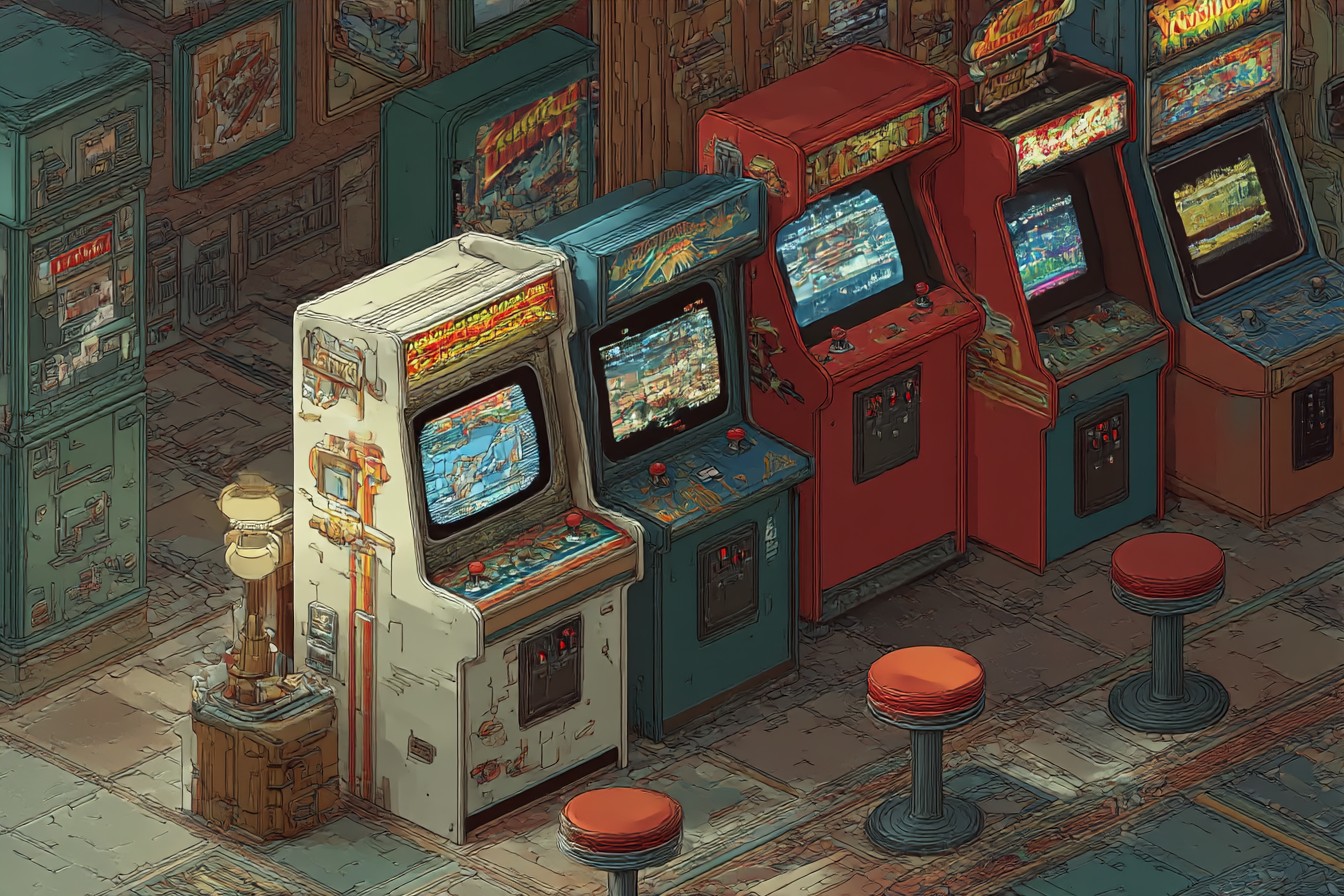
The arcade section wasn’t huge – maybe eight cabinets lined up against the back wall, but those machines might as well have been portals to other dimensions. I’d survey the lineup like a general planning a campaign, mentally calculating which games would give me the most bang for my buck. Do I blow three quarters trying to finally beat Double Dragon, or do I spread it around and sample everything?
Galaga owned my soul for the better part of 1986. I must’ve pumped fifty dollars into that machine over the course of a summer, all chasing that perfect game where everything clicks and you’re in the zone, dodging enemy fire like some kind of pixel-powered Neo. The high score table on that machine was serious business – seeing “SAM” up there in the top spot felt better than any report card I ever brought home.
You learned arcade etiquette fast or you got schooled by kids who’d been there longer. Coins lined up on the bezel meant you’d called next, and everyone respected that queue. No exceptions. I watched this one kid try to jump the line on Street Fighter II once, and the entire pizza place basically shunned him until he apologized. We were all broke, we all wanted to play, but fairness mattered.
The cabinet rotation was always exciting and terrifying. One week you’d walk in and boom – there’s this brand new machine you’d never seen before, usually positioned right in the prime spot where everyone could see it. I remember when they first wheeled in Street Fighter II in early ’92. Word spread through my middle school faster than news about a surprise fire drill. Suddenly every conversation revolved around whether you were a Ryu guy or a Ken guy, and if you claimed you could pull off Zangief’s spinning piledriver, you better be ready to prove it.
OutRun sat in the corner like a shrine to everything I thought was cool about being an adult. That red Ferrari cockpit, the force feedback steering wheel that actually had weight to it, the radio selection that made you feel like you were choosing the soundtrack to your own movie. I’d grip that wheel and lean into every turn like my body English could somehow improve my lap times. Probably looked like an idiot. Didn’t care even slightly.
Tony, the owner, got what he had going. This wasn’t just about selling pizza to families – he was running the unofficial community center for every kid within biking distance. When machines broke down, he’d have them fixed within days, not weeks. When the older high school kids started getting too rowdy around the younger players, he’d wander over and calm things down without making anyone feel like they were in trouble. Smart business, really. Those arcade cabinets were basically printing money.
The fighting game explosion changed everything. After Street Fighter II proved that complex control schemes could work, it seemed like every company rushed to get their own fighter into arcades. Fatal Fury showed up, then Mortal Kombat with its infamous fatalities that had parents clutching their pearls and demanding to speak to managers. We’d crowd around those machines like ancient tribes gathering around campfires, passing down secret knowledge about special moves and hidden characters.
I learned more about human psychology from arcade culture than I ever did in actual psychology class. Watching how different kids handled winning and losing, how natural hierarchies formed based purely on skill rather than age or social status. The quiet girl from my math class turned out to be absolutely lethal at Bubble Bobble. The star quarterback couldn’t make it past the first level of Ghosts ‘n Goblins to save his life. Talent was the only currency that mattered, and it was impossible to fake.
The competitive aspect was intoxicating in a way that modern online gaming can’t quite replicate. When you put up a high score, it stayed there for everyone to see until someone knocked you off. Your initials on that leaderboard were like planting a flag – proof you’d been there, proof you’d conquered whatever challenge the game threw at you. Some scores lasted for months. I held the top spot on Robotron 2084 for an entire summer and felt like the king of the world.
Then there were the legendary moments that became part of local folklore. The day someone actually beat Contra without using the Konami code. The afternoon when this kid nobody knew walked in and proceeded to demolish everyone at Street Fighter II using characters most of us had never even seen before. The great Mortal Kombat controversy when parents started showing up to see what all the fuss was about. These weren’t just gaming sessions – they were shared experiences that bonded everyone who witnessed them.

Looking back now, I realize Tony’s Pizza & Games was where I learned most of my social skills. How to handle losing gracefully, how to celebrate victory without being a jerk about it, how to help younger kids without talking down to them. The arcade fostered this weird democratic meritocracy where your age, your clothes, your family’s income – none of that mattered. Could you beat Gradius on one quarter? That’s what counted.
The end came gradually, then all at once. Newer games required more complex hardware, driving up costs for operators like Tony. Home consoles got better, giving kids arcade-quality experiences without leaving the house. The fighting game scene moved to dedicated gaming centers in the city. By the mid-90s, half the cabinets were gone, replaced by ticket-dispensing games and prize counters that turned gaming into a weird shopping experience.
Tony’s closed for good in 1997, right around the time I started high school and discovered other interests. I drove past the empty building a few years later – it’s a cellphone store now, which feels appropriately depressing. But sometimes I’ll be walking through a modern arcade at some family entertainment center, and I’ll catch a whiff of that particular combination of electronics and industrial cleaning supplies, and I’m twelve years old again with a pocket full of quarters and infinite possibilities stretching out in front of me.
My kids think I’m exaggerating when I tell them about the old arcade days. They’ve got every game imaginable on their phones, perfect emulation on their computers, online multiplayer that connects them to players worldwide. But they’ve never experienced the weight of real quarters in their palm, never felt that stomach-drop moment when you’re down to your last life and your last coin. They’ll never know the pure social electricity of a crowd gathered around a cabinet, watching someone attempt something genuinely difficult with real stakes on the line.
I’ve got MAME set up in my basement now, with authentic arcade sticks and everything. Perfect emulation, save states, unlimited continues. But you know what it can’t replicate? That sticky carpet under my sneakers, the sound of quarters hitting the change machine, the way victory felt when it cost you something real. Some experiences just can’t be downloaded.

Samuel’s been gaming since the Atari 2600 and still thinks 16-bit was the golden age. Between accounting gigs and parenting teens, he keeps the CRTs humming in his Minneapolis basement, writing about cartridge quirks, console wars, and why pixel art never stopped being beautiful.