Back in 1993, I was deep into my Sega fanboy phase—you know, the kind where you’d defend Altered Beast as a masterpiece just because it came with your Genesis. I’d already burned through Sonic 1 and 2 probably fifty times each, had my copy of Streets of Rage 2 practically memorized, and was starting to branch out into the weirder corners of the Genesis library. That’s when I stumbled across Rocket Knight Adventures at my local game shop, tucked between some sports games nobody wanted.
The cover art caught me immediately. This armored opossum with a sword and jetpack, looking like he’d stepped out of some Saturday morning cartoon I’d want to watch. The guy behind the counter—Larry, who knew way too much about import games and always smelled like cigarettes—told me it was “that new Konami joint” and that I should give it a shot. Best twenty-eight bucks I spent that summer, honestly.
I remember popping it in that first time and just sitting there through the opening sequence. The music hit you right away—this sweeping orchestral piece that made the Genesis sound like it was channeling a full symphony. I mean, I thought I knew what the YM2612 could do after hearing Yuzo Koshiro’s work on Streets of Rage, but this was something different entirely. All brass and strings and this sense of epic adventure that made you feel like you were about to embark on something special.
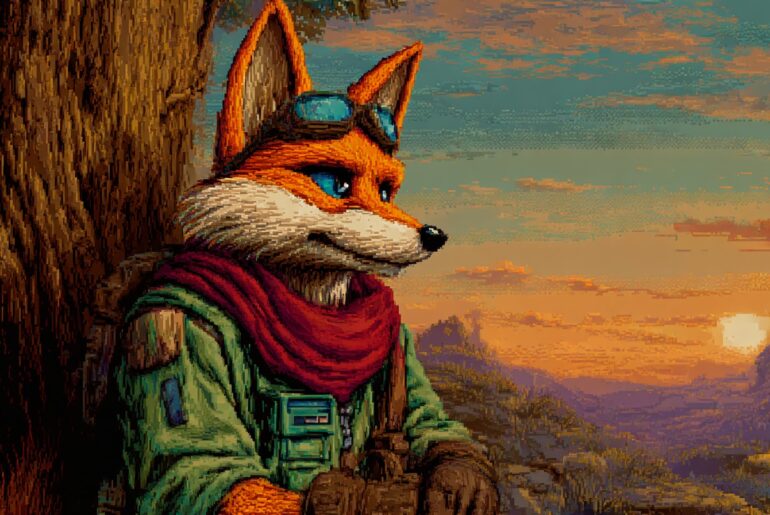
Then Sparkster appeared on screen and everything clicked. This wasn’t just another mascot platformer trying to ride Sonic’s coattails. The way he moved, the way the jetpack physics worked, even the way his armor caught the light—everything felt deliberate and polished in a way that reminded you why Konami had such a solid reputation back then.
The controls took some getting used to, I’ll give you that. You couldn’t just hold the rocket button and fly around like Superman. The fuel system meant you had to think about momentum, about charging up your thrust and then using it strategically. I spent probably an hour just in that first level, bouncing Sparkster off walls and experimenting with different flight patterns. My Genesis controller developed this permanent groove in the charge button from all my experimenting.
What really sold me on the game was how the jetpack wasn’t just transportation—it was your primary weapon, your puzzle-solving tool, your means of exploration all rolled into one. You’d charge up and blast into enemies like a furry missile, ricochet off surfaces to reach hidden areas, build momentum to clear massive gaps. The sword combat was solid too, don’t get me wrong, but that jetpack made everything feel dynamic in ways I hadn’t experienced before.
Each level felt like this massive set piece designed specifically around Sparkster’s abilities. I’m thinking about that sequence where you’re riding on the back of some giant mechanical pig—because of course that’s a thing that happens in this game—dodging tree branches and blasting robot wolves while this contraption lumbers through the forest. Or the part where you get launched from a cannon and have to navigate mid-air while dodging artillery fire. Pure Konami weirdness, but executed with this level of craft that made all the absurdity feel perfectly natural.
The boss fights were absolutely mental. These towering mechanical monstrosities with multiple phases and attack patterns you had to learn through repeated failure. I got completely stuck on this one robot that would grab Sparkster and try to crush him—kept messing up the escape sequence timing. Took me probably two weeks of intermittent attempts before I figured out you had to start the button inputs earlier than seemed logical. Those moments when you finally nail a boss pattern though… pure satisfaction.
Visually, the game was just gorgeous. Every sprite had personality, every background was packed with these little details that made the world feel alive. The enemy designs were wonderfully bonkers—robot wolves, armored pigs, these bizarre mechanical birds that looked like they’d escaped from some steampunk nightmare. And the animation was so smooth, especially Sparkster’s movement. You could feel the weight of his armor, the power of his rockets, the precision of his sword work.
The music kept pace with everything perfectly. Each level had its own musical identity, from heroic marching themes to more atmospheric underground sections. That final boss music is still lodged in my head thirty years later—all urgent strings and pounding drums building to this crescendo as you face down whatever massive mechanical horror Konami cooked up for the finale.
Playing it now on my RetroTINK setup, the game holds up remarkably well. The physics still feel tight, the controls are still responsive, and that core jetpack mechanic remains as satisfying as ever. I showed it to my daughter a few months back—she was initially skeptical about playing as what she called “a metal hamster,” but within twenty minutes she was bouncing around levels with the same manic energy I remember from those summer afternoons in ’93.
What strikes me most about Rocket Knight Adventures is how purposeful everything feels. Konami didn’t just take a standard platformer and bolt on a jetpack—they built the entire experience around that one central mechanic. Every enemy placement, every level design choice, every boss pattern was crafted with Sparkster’s unique movement abilities in mind. It’s the kind of focused game design that feels almost quaint compared to today’s kitchen-sink approach to features.
The sequels never quite captured the same magic. Sparkster on Genesis was decent but felt rushed, and the SNES version had some nice moments but lacked the original’s cohesive vision. That 2010 revival attempt… well, let’s just say some things are better left in the past.
These days, whenever retro gaming discussions turn to “hidden Genesis gems,” I always champion Rocket Knight Adventures. It represents everything I loved about the 16-bit era—creative ambition, technical polish, and this willingness to embrace complete absurdity as long as it served the gameplay. In an era dominated by mascot platformers all trying to be the next Sonic, Konami managed to create something that felt both familiar and completely unique.
We need more games with that kind of confident weirdness today. More titles willing to build everything around one brilliant central mechanic and see where it takes them. Rocket Knight Adventures proved that sometimes the best approach is to embrace the absurd—armored opossum with jetpack and all—and commit to it completely.

Joe’s a history teacher who treats the console wars like actual history. A lifelong Sega devotee from Phoenix, he writes with passion, humor, and lingering heartbreak over the Dreamcast. Expect strong opinions, bad puns, and plenty of “blast processing.”