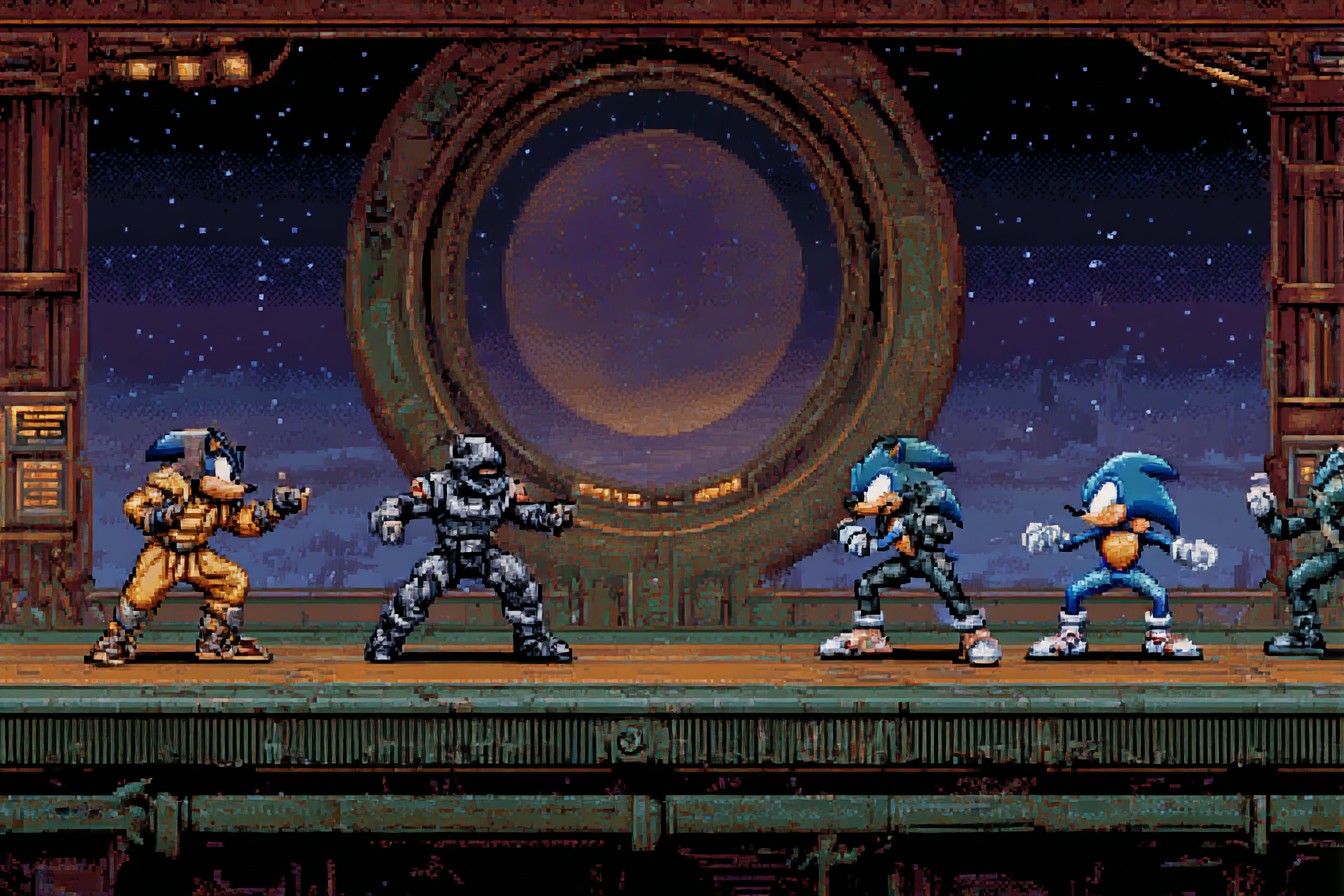
My buddy Jake claimed he could nail Sub-Zero’s spine rip fatality every single time. This was 1995, we’re crammed into his basement rec room that always smelled like stale pizza and that weird musty carpet smell, and Jake’s going absolutely nuts on his six-button Genesis controller like he’s trying to break it. Here’s the thing about Mortal Kombat 3 on Genesis though – it wasn’t just about button mashing. You couldn’t just flail around and hope something cool would happen. I mean, you could try, but you’d end up like Jake did most of the time: getting his ass handed to him by Cyrax’s net combos while sweating through his Nirvana t-shirt.
I found the move lists buried in that thick manual, and man, remember when game manuals were actually worth reading? Not like today where you get a folded piece of paper with the warranty info. The MK3 manual was like a sacred text – full of character backgrounds and, more importantly, the exact button sequences you needed to rip someone’s head clean off their shoulders. That manual lived on my nightstand for months, pages getting worn from constant reference.
Sub-Zero’s spine rip looked simple on paper: Forward, Down, Forward, High Punch. But execution? Completely different story. The timing had to be absolutely perfect, your distance from the opponent exact, and they needed to be stunned just right from that final hit. I probably burned entire weekends just practicing that one sequence, developing these weird thumb calluses from hammering those Genesis controller microswitches. The satisfying click of those buttons became like a metronome for digital violence.
What really got me about MK3 wasn’t just the fatalities, though obviously those were the main draw. It was how different the home version felt compared to the arcade. The Genesis had this particular sound quality – that YM2612 sound chip gave everything this gritty, compressed quality that made every punch sound like it was being fed through a broken amplifier. The SNES version sounded cleaner, sure, but it didn’t have that raw, metallic edge that made the Genesis version feel genuinely brutal.
I gravitated toward Cyrax because his moves just clicked with how I naturally gripped the controller. His net throw – Back, Back, Low Kick – was stupidly effective against friends who hadn’t memorized the escape timing yet. I’d snare them in that green web and either go for a quick uppercut or, if I was feeling fancy, set up his self-destruct fatality. That one was genuinely challenging: Hold Low Kick, then Far, Far, Back, Up. Mess up the timing and you’d just stand there looking like an idiot while your opponent recovered and promptly demolished you.
The combat system rewarded thinking over button mashing, which was revolutionary for my teenage brain. Each character had their own flow, their own rhythm of attacks that only worked when you understood spacing and timing. Kabal’s spin move could absolutely wreck aggressive players, but whiff it and you were completely exposed. His hookswords gave him solid reach, but landing his fatalities required positioning that felt almost like a dance. That backward-forward-backward sequence for his blade spin had to be executed at precisely the right distance, or you’d slash at empty air while your opponent stood safely across the screen, probably laughing at you.
I spent most of one summer vacation mastering Sindel’s hair whip combinations. Her moveset was probably the most technical in the entire game – those floating fireball patterns demanded real finger dexterity, and her scream attack could surprise people if you’d trained them to expect her aerial approach. But her fatalities? Jesus, they were disturbing. That scream that completely shattered your opponent’s body was so unsettling that my little sister would actually leave the room whenever I picked Sindel.
The six-button Genesis pad was absolutely essential for getting MK3’s full experience. Trying to play with the original three-button controller was like trying to perform surgery wearing oven mitts. The button layout made those crucial high-punch, low-punch combinations possible – the foundation of most special moves. I actually developed legitimate calluses on my thumbs from those microswitches. Battle scars from countless hours perfecting quarter-circle motions and charge commands.
What’s interesting is how the blood code controversy had basically evaporated by the time MK3 came out. The original Mortal Kombat’s A-B-A-C-A-B-B sequence had caused such an uproar that by ’95, parents had mostly surrendered trying to monitor digital violence. My mom would walk past the TV, see Sub-Zero decapitating someone with their spine still dangling, and just shake her head with a “boys will be boys” attitude. The moral panic had moved on to other targets, leaving us free to explore Midway’s full grotesque creativity.
The differences between arcade and home versions always fascinated me. The Genesis couldn’t quite match the arcade’s processing power, so certain characters got modified or simplified. But honestly? I actually preferred some of the home version’s quirks. The slightly altered timing on combos meant that strategies I developed in my bedroom wouldn’t necessarily work at the arcade, and vice versa. It created this parallel universe of fighting game knowledge that felt uniquely ours.
Training modes didn’t really exist back then – you learned by getting repeatedly destroyed by your friends or by cranking the CPU difficulty up and getting humiliated by the computer. I’d spend hours in single-player mode, not actually trying to beat the game, but drilling specific sequences until they became automatic. The muscle memory required for Shang Tsung’s morphing combinations was legitimately demanding. You had to input the transformation, wait for the animation, then immediately execute the new character’s moveset before changing back. Screw up the timing and you’d morph into Kano right as your opponent landed a combo that would’ve completely whiffed your original form.
Even today, I can still execute most of those classic MK3 combinations without conscious thought. The patterns are permanently etched into my motor memory alongside things like riding a bike or touch typing. Sometimes I’ll catch myself unconsciously performing quarter-circle motions on my desk while thinking about work stuff, my fingers automatically tracing paths they learned on a plastic controller when life was simpler and Saturday afternoons felt infinite.
That’s what made MK3 on Genesis special – not just the fatalities or the controversy, but how it taught us that real mastery came through repetition, patience, and just the right amount of healthy obsession. Those calluses on my thumbs were worth every perfectly executed spine rip.

Samuel’s been gaming since the Atari 2600 and still thinks 16-bit was the golden age. Between accounting gigs and parenting teens, he keeps the CRTs humming in his Minneapolis basement, writing about cartridge quirks, console wars, and why pixel art never stopped being beautiful.