Right, so there I was last weekend, trying to sort through the disaster zone that passes for our spare bedroom—you know the type, where broken electronics go to die alongside those Christmas decorations you swear you’ll use again but never do—when I stumbled across something that stopped me dead in my tracks. A proper thick stack of A4 paper, held together with what remained of a rusty staple, covered in coffee rings and my own terrible handwriting from about twenty-odd years ago. My complete Paper Mario walkthrough, printed off GameFAQs sometime in 2001, and looking like it had been through a washing machine.
Funny thing is, just touching those crumpled pages brought it all rushing back. The N64 was already feeling long in the tooth by 2000, what with the PlayStation doing its polygon wizardry and the Dreamcast showing us what proper online gaming might look like. But then Nintendo dropped this absolute gem on us, and I remember thinking, “bloody hell, they’ve actually done it.” Here was the company that gave us jumping plumbers making a proper RPG, and somehow it worked better than games that had been trying to perfect the formula for years.
I’d been neck-deep in RPGs since the mid-90s, right? Final Fantasy VII had already rewired my brain with its materia nonsense and that bit with Aerith that we’re still not over. I’d put hundreds of hours into Chrono Trigger, probably knew every branching timeline better than my own family history. But Paper Mario was different—it was Nintendo being Nintendo, taking this whole RPG thing and doing something completely mental with it.
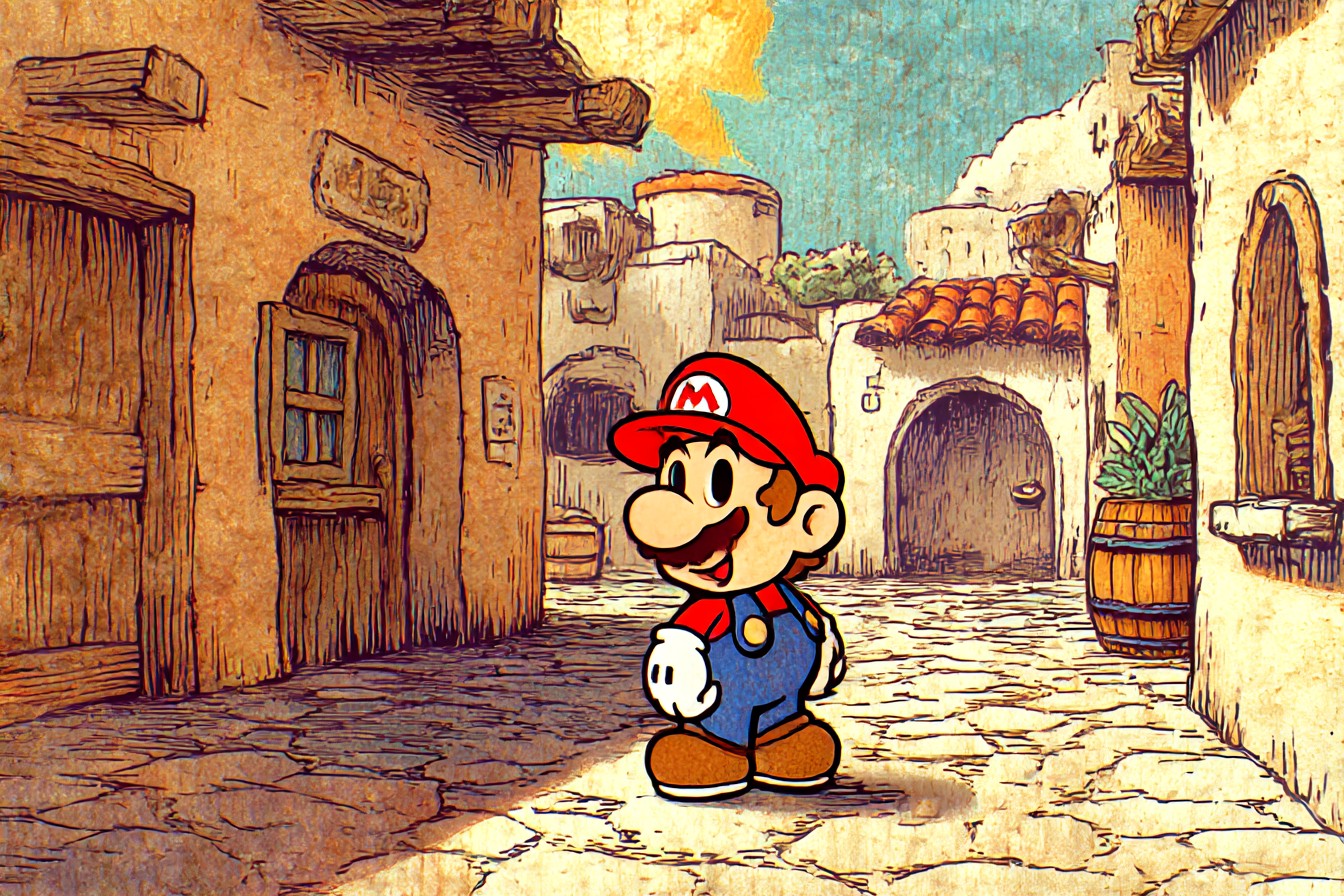
The visual design was pure genius, and I’m not just saying that because I was easily impressed back then. Instead of trying to compete with Sony’s polygon-pushing tech, Intelligent Systems went completely sideways. Literally sideways, since Mario was basically a cardboard cutout living in a pop-up book. I’d spend ages just rotating the camera to watch him vanish when he turned edge-on, like some sort of gaming magic trick. The backgrounds looked like someone’s art class had exploded in the best possible way—all construction paper textures and handmade charm. Even now, when I fire it up on my EverDrive (yes, I’m that preservation nerd who bangs on about original hardware), it still looks absolutely timeless. Can’t say the same for most polygonal characters from 2000, can we?
But here’s what really got me hooked—the combat system was nothing like the turn-based slogs I’d grown accustomed to. Every attack had these action commands where you’d time button presses to deal extra damage or reduce incoming hits. Suddenly I wasn’t just selecting “Jump” from a menu and watching numbers appear; I was actively involved in every single combat exchange. My missus still takes the piss out of how I’d physically lean into the controller during boss fights, like my body language could somehow improve Mario’s timing. Probably looked like an absolute muppet, but it felt important at the time.
The badge system was like crack for completionist types like me. You’d find these little pins scattered around the world—some obvious, others hidden behind fake walls or earned through obscure side quests. Each badge gave Mario new abilities or stat boosts, but you had limited badge points to spend, so every decision mattered. Do you equip the one that shows enemy health bars, or the one that occasionally makes you dodge attacks automatically? I’d spend proper ages in that badge menu, shuffling equipment around like I was preparing for the World Cup.
Partner characters were another brilliant touch. Each one had distinct personalities, combat abilities, and overworld functions. Kooper could knock switches from across rooms. Bombette opened up new paths by exploding cracked walls. Lady Bow could turn the whole party invisible to sneak past certain enemies. They weren’t just combat tools—they were puzzle solutions and genuinely funny characters with proper chemistry. The writing for each partner felt more developed than main characters in other games I’d played.
I’ll never forget my first time through Shy Guy’s Toy Box. That twisted carnival nightmare of a chapter where you’re shrunk down and navigating this oversized playroom filled with wind-up enemies and toy trains. The music was this unsettling music box melody that would get properly stuck in my head for days afterward. Even now, I can hum a few bars and get slight chills. That’s the kind of atmospheric design that separates good games from the ones you’re still thinking about decades later.
The writing was what really sealed the deal though. Nintendo’s localization team was absolutely on fire. Every random NPC had personality quirks and running gags. The Toad Town inhabitants had ongoing storylines that developed as you progressed through chapters. There was this one green Toad obsessed with cooking experiments, and I’d check in on him religiously just to see what culinary disaster he’d attempted next. Proper character development in what could’ve been throwaway NPCs.
Boss fights were like theatrical performances disguised as combat encounters. Tutankoopa commanding his Chomp mummy in the desert pyramid. The Crystal King summoning ice duplicates while wind effects howled through the speakers. General Guy orchestrating his entire Shy Guy army from that ridiculous tank. These weren’t just stat checks or pattern memorization—they were spectacles where you had to figure out the gimmick while executing perfect action command timing.
That crumpled walkthrough got more use than I care to admit. Not because Paper Mario was impossibly difficult—Nintendo kept things reasonably accessible—but because I was paranoid about missing content. Star Pieces hidden behind unmarked walls. Badge shops tucked away in corners you’d never think to explore. Optional super bosses that required specific strategies and equipment setups. The guide became my security blanket, covered in highlighter marks and Post-it notes tracking my completion percentage.
Looking back at my penciled-in annotations now, half of them are completely wrong. I’d written “FIRE ATTACKS ONLY” next to bosses that were actually weak to ice damage. I’d marked certain badges as “essential” that I now realize were pretty average at best. But that’s the beauty of being properly passionate about something when you’re younger—you dive in headfirst, even when you haven’t got a clue what you’re doing.
These days I could probably play through Paper Mario blindfolded. I know every hidden block location, which random Toad gives the best gossip, exactly when to use each of Mario’s jump variants for maximum style points. But sometimes I miss that first playthrough confusion—the genuine surprise when simple fetch quests evolved into something deeper, the satisfaction of finally cracking a badge combination that made Mario nearly unstoppable.
Paper Mario proved Nintendo could approach RPGs on their own terms—charming rather than grimdark, clever instead of needlessly complex, genuinely memorable without taking itself too seriously. It respected both kids’ intelligence and adults’ time constraints, delivering real emotional moments without drowning in its own self-importance.
That old printout’s going back in the drawer, coffee stains and terrible handwriting intact. Some artifacts are worth preserving, even when you don’t actually need them anymore. They remind you why certain games matter, why some experiences stick with you long after the credits roll. Paper Mario was one of those special ones—a game that understood exactly what it wanted to be and executed that vision perfectly.

John grew up swapping floppy disks and reading Amiga Power cover to cover. Now an IT manager in Manchester, he writes about the glory days of British computer gaming—Sensible Soccer, Speedball 2, and why the Amiga deserved more love than it ever got.