Saturday afternoon, 1997. I'm sprawled across the carpet of my mate Dave's living room, the kind with those swirly brown patterns that could hide Cheerios and shame in equal measure. The N64's been out for a year, and we've already worn grooves in Mario 64's castle floors, but today's different. Dave's sliding a new cartridge into that front-loading slot with the reverence of a priest handling communion wine.
"My brother got it from Blockbuster," he says, like that explains everything. And honestly? It did. Blockbuster was our gateway to gaming risk—three nights to fall in love or write off fifty pence as education.
The cart's got this weird tribal art on it, all earth tones and angular dinosaur silhouettes. Turok: Dinosaur Hunter. Never heard of it, but the back of the box shows a bloke with a bow facing down what looks like a T-Rex wearing battle armor. I mean, come on. You don't need to sell me twice.
Boot it up, and immediately you know this isn't Mario. The Acclaim logo hits with that metallic sting, and then you're dumped into fog. Proper fog, not the cute white clouds that Nintendo uses to hide distant polygons. This is atmospheric fog, the kind that makes you lean forward on the sofa because something might be lurking just beyond your vision.
That fog became Turok's signature, didn't it? People complained about it back then—called it a technical limitation, a cop-out to hide the N64's relatively modest draw distance. But honestly? Playing it now, decades later, I think they got it backwards. That fog wasn't hiding anything—it was creating tension. Every step forward revealed new horrors. Every cleared area felt like a small victory against the unknown.
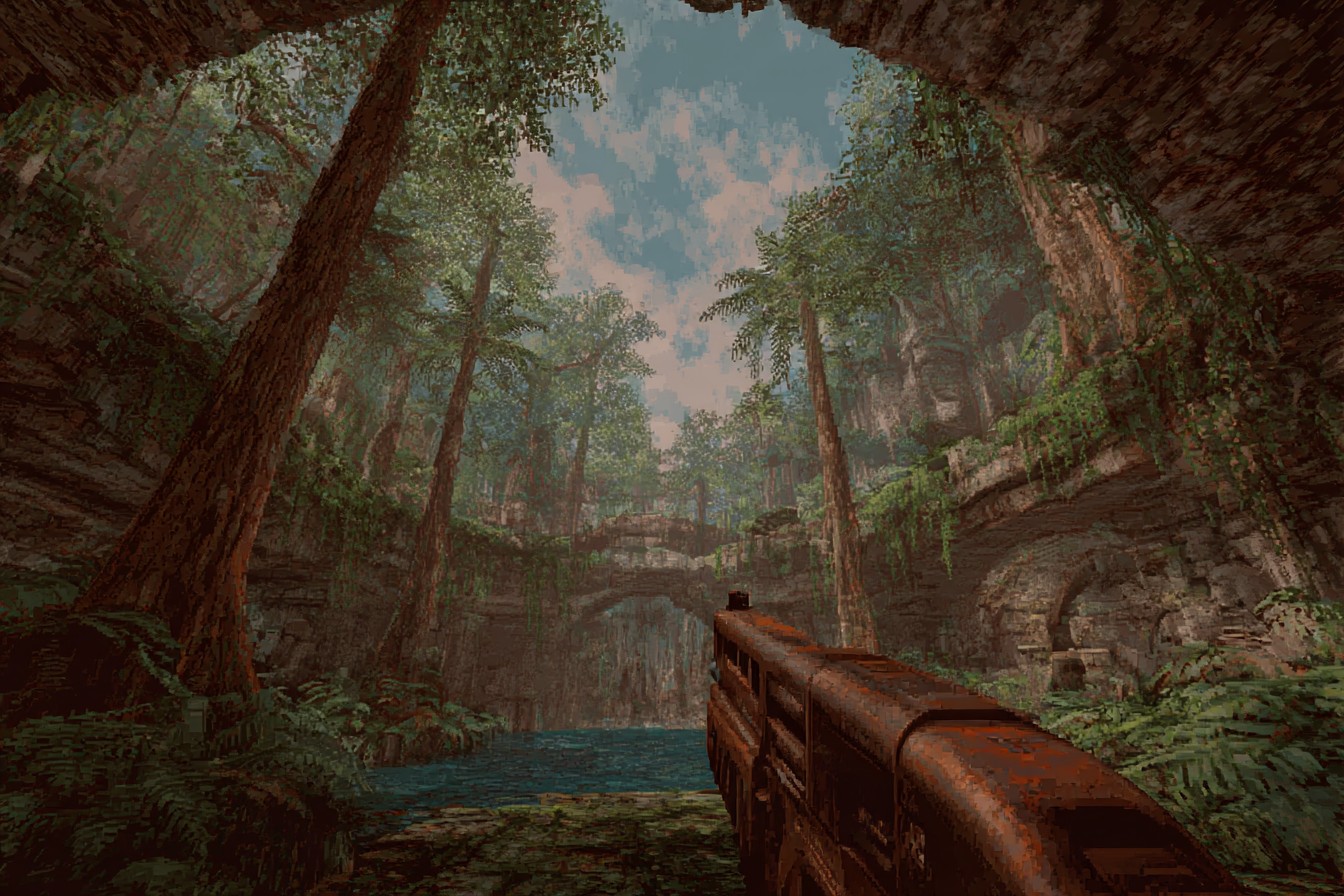
The opening level drops you into this primordial jungle where the trees look carved from green polygons and the ground squelches under your feet with satisfying audio feedback. Within thirty seconds, you've picked up your first weapon—a knife that feels reassuringly chunky in your hands—and encountered your first enemy. Not a dinosaur, mind you. A poacher. Because apparently time-traveling dinosaur hunting attracts the wrong sort of crowd.
But then you hear it. That roar. Deep, primal, coming from somewhere beyond the fog wall. Dave and I exchange glances. We both know what's coming, but knowing doesn't prepare you for your first raptor encounter. They move fast—faster than anything we'd faced in Mario or Zelda. The N64's analog stick suddenly feels essential, not optional. Circle strafing becomes muscle memory within minutes.
Turok understood something that a lot of early N64 games missed: the analog stick wasn't just for moving around—it was for aiming. Sure, the auto-aim helped (thank god for auto-aim), but there's something deeply satisfying about manually lining up a shot with that bow, especially when you nail a perfect headshot on a charging velociraptor. The controller's Z-trigger made every shot feel deliberate, weighty.
The weapons, though. That's where Turok went completely mental in the best possible way. You start with basic stuff—a knife, a bow, a pistol that sounds like it's firing cap gun strips. But gradually, the game starts handing you increasingly ridiculous firepower. The Tek Bow fires explosive arrows. The Pulse Rifle sounds like it's tearing holes in reality. And then there's the Chronoscepter—a weapon so overpowered it makes the BFG 9000 look like a water pistol.
I remember the first time we found a Chronoscepter power cell. Dave's reading the instruction manual (remember when games came with actual manuals?) while I'm getting chomped by a T-Rex for the fifth time. "Says here the Chronoscepter disintegrates enemies," he reads aloud. We both pause. Disintegrates? In a Nintendo game? This was pre-Teen rating, remember. Nintendo was still the family-friendly console.
But there it was—enemies getting zapped into particle effects, leaving behind nothing but floating power-ups and our increasingly maniacal laughter. The game had this wonderful cognitive dissonance where cartoon-violent effects met genuinely intense action. It felt transgressive in a way that Mortal Kombat's blood couldn't match.
The level design deserves credit too, though it took me years to appreciate it properly. At the time, I just knew I was constantly lost. These weren't linear Mario levels—they were proper 3D mazes with vertical elements, secret areas, and multiple paths to the same objective. You needed those Turok Keys to progress, but finding them meant exploring every nook and cranny of these sprawling prehistoric landscapes.
Looking back, Turok was teaching us how to navigate 3D space without holding our hands. No mini-map, no quest markers, just environmental landmarks and player intuition. That waterfall with the hidden cave behind it. The plateau where the Purr-linn (those weird cat creatures) liked to ambush you. The bridge where someone always, always fell into the lava below.
The enemies were properly varied too, which sounds obvious until you remember how many early 3D games just threw palette-swapped versions of the same three models at you. Turok had raptors, T-Rexes, Triceratops, flying Pteranodons, those aforementioned Purr-linns, various human enemies with different weapons and tactics, and boss creatures that genuinely required strategy to defeat.
Boss fights in Turok weren't just about circle strafing and shooting—though there was plenty of that. The Campaigner, that cyborg T-Rex that serves as the game's final boss, demanded pattern recognition, weapon management, and genuine skill. No continues, no saves mid-fight. You either learned his moves or you started over.
The sound design deserves a mention here. Turok's audio was properly atmospheric—jungle ambience that made you feel like you were being watched, weapon sounds that had genuine impact, and those dinosaur roars that came through the TV speakers with enough bass to rattle the china cabinet. The music, composed by Darren Mitchell, struck this perfect balance between tribal drums and electronic synths that somehow made ancient jungles feel like alien worlds.
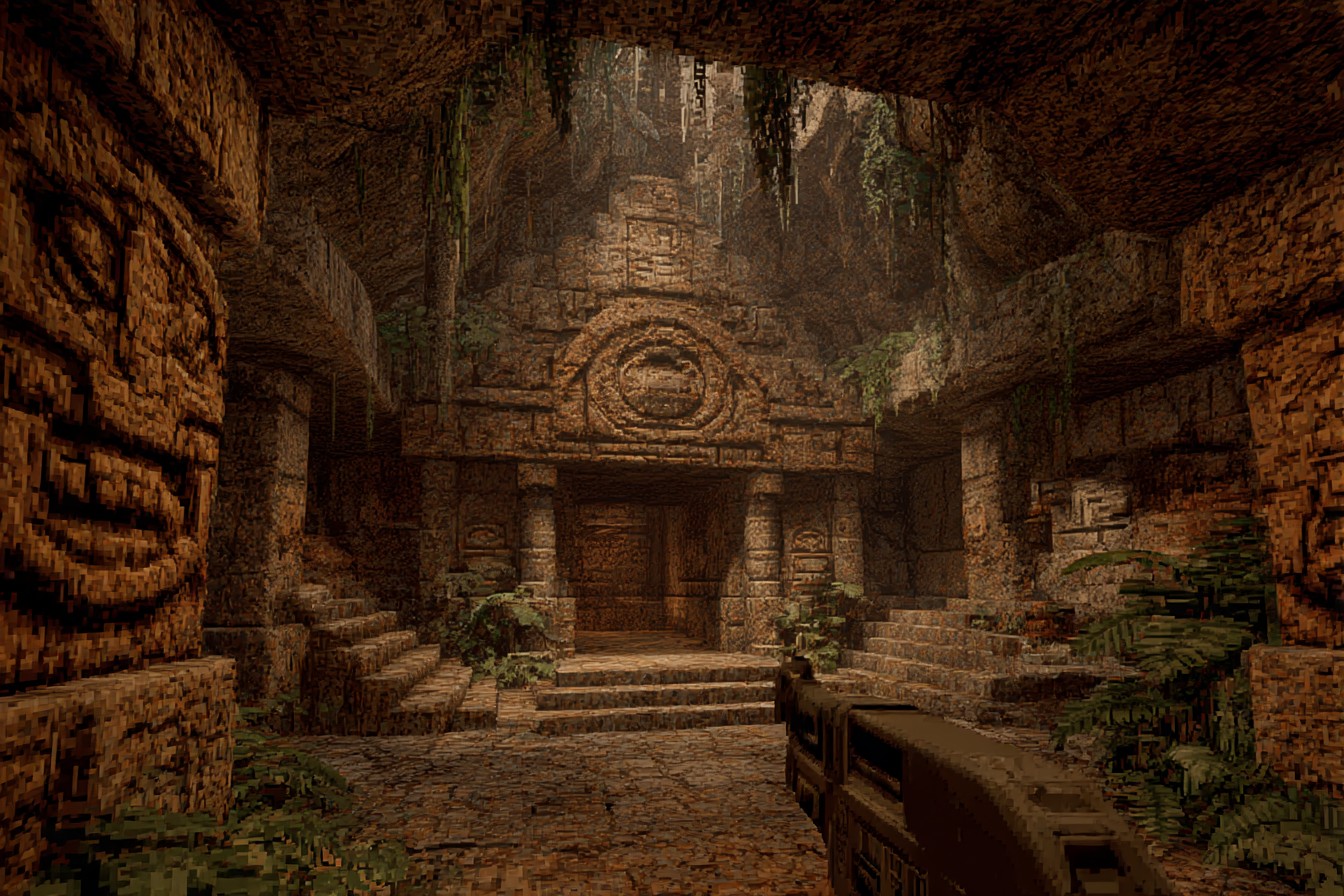
Performance-wise, yeah, Turok had its moments. The frame rate could chug when too many enemies appeared on screen, and those fog walls were clearly doing heavy lifting to keep the N64 from melting. But here's the thing—it ran better than most early N64 games, and the gameplay was smooth enough that technical hiccups felt like minor annoyances rather than deal-breakers.
What really made Turok special, though, was how it felt like a proper PC shooter translated to console without losing its identity. This wasn't a simplified, family-friendly version of Doom or Quake. This was violent, challenging, and unapologetically focused on adult gamers who wanted something with more bite than Mario's castle romps.
Playing Turok today—whether on original hardware or through modern ports—it's remarkable how well the core gameplay holds up. The weapons still feel satisfying, the enemies still provide genuine challenge, and that fog still creates tension in ways that modern games struggle to match. Sometimes limitations breed creativity, and Turok's technical constraints forced the developers to focus on atmosphere and gameplay in ways that pure horsepower might have diluted.
It wasn't the most technically impressive N64 game, nor the most innovative. But it was dinosaurs, explosions, and time travel wrapped up in a package that respected its players' intelligence. What more could you want from a Saturday afternoon?