Found myself digging through a dusty electronics store last Saturday – you know the type, smells like old circuit boards and broken dreams – when I spotted something that made me stop dead in my tracks. There, wedged between a stack of VHS copies of “Titanic” and some scratched-up PlayStation discs, sat a Game Gear that had definitely seen better days. Screen cracked like a spider web, battery compartment corroded to hell, but man…holding that chunky piece of plastic took me right back to being thirteen years old and thinking I owned the coolest piece of tech on the planet.
People always talk about Nintendo winning the handheld wars with the Game Boy, and sure, commercially they crushed everyone. But here’s the thing nobody wants to admit: Sega was making handhelds that were legitimately years ahead of their time. The Game Boy was this beige brick that displayed everything in sickly green pixels, while Sega rolled up in 1990 with full color, backlit screens, and actual Master System games crammed into a portable form factor. It was like comparing a calculator to a pocket television.
I got my Game Gear for Christmas in ’91 after months of begging. My friend Derek had one, and I’d spent entire afternoons at his house just watching him play Columns, mesmerized by those falling gems in actual, real colors. Not green. Not slightly-different-green. Actual blue and red and yellow pixels dancing around on that gorgeous little screen. The specs don’t sound impressive now – 3.58 MHz processor, 8KB of RAM – but this thing was running full Master System titles while the Game Boy was stuck with simplified, stripped-down versions of NES games.
The library was incredible if you knew where to look. Everyone remembers Sonic, obviously – seeing those green hills and blue skies in proper color was mind-blowing after years of monochrome Mario. But dig deeper and you’d find stuff like Shining Force Gaiden, this tactical RPG that had no business being that complex on a handheld. Or GG Shinobi, which gave you multiple ninja characters with different abilities. Hell, even The Lion King looked amazing, with animation that would’ve been impossible on Nintendo’s hardware.
That screen though…that was the real game-changer. Backlit LCD in 1990. Think about that. While Game Boy kids were squinting under desk lamps or buying those ridiculous magnifying glass contraptions with built-in lights, we could play anywhere. Car rides became tolerable. Could actually play under the covers without alerting parents with a flashlight. I spent countless summer evenings lying on my bedroom carpet, elbows propped up, completely lost in games that looked like they’d been beamed down from arcade cabinets.
Course, nothing’s perfect. Battery life was…well, calling it “terrible” would be generous. Six AAs would get you maybe three hours if you were careful, less if you cranked the volume up – which you absolutely had to because the audio was surprisingly good for a handheld. I became a master of battery conservation. Dimming the screen just enough to squeeze out another level of Sonic. Timing bathroom breaks with natural pause points. My dad’s expression when he saw our monthly battery budget…let’s just say Energizer rechargeable AAs became a household staple real quick.
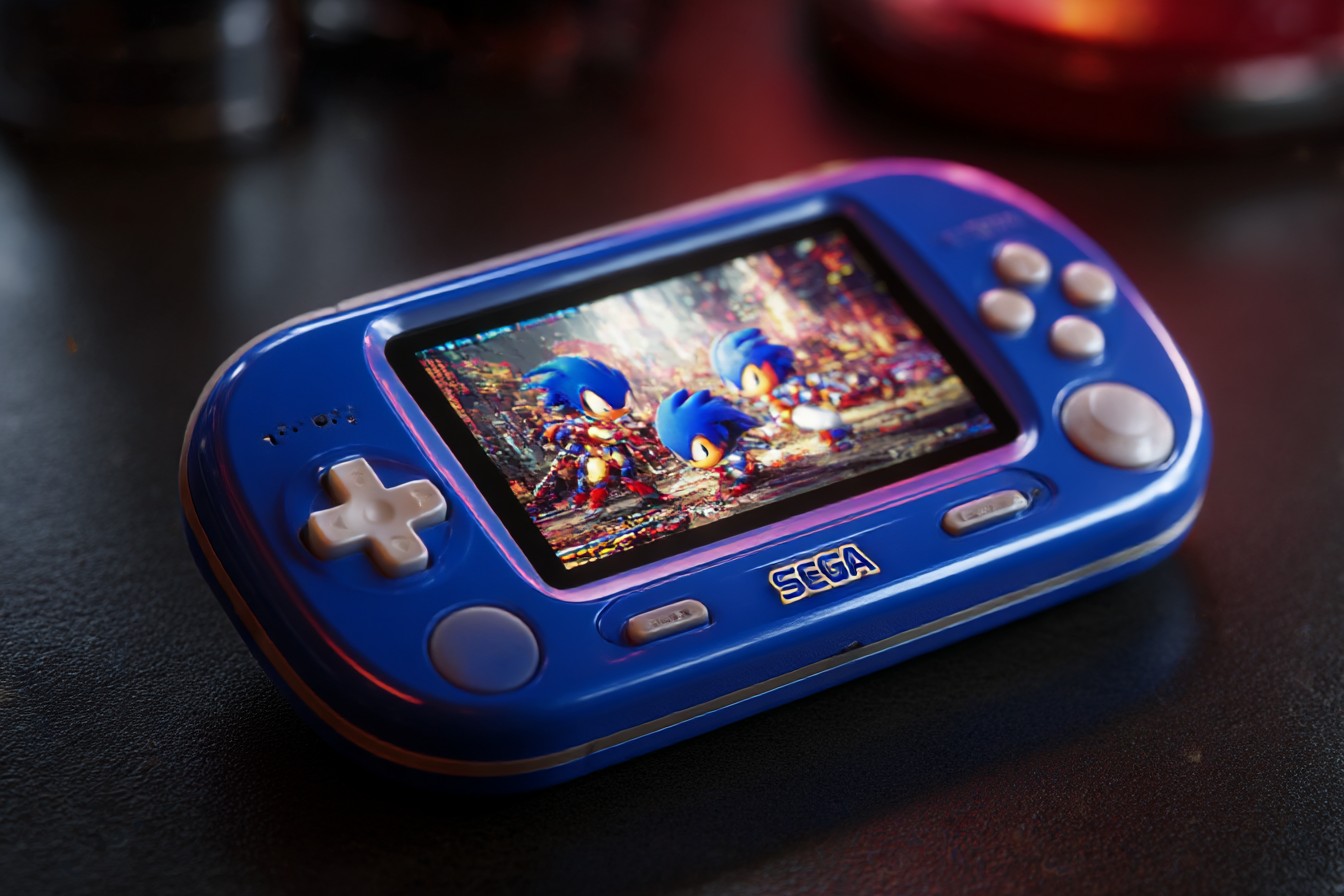
Then 1995 rolled around and Sega completely lost their minds with the Nomad. Picture this insanity: take a Genesis, shrink it down to handheld size, slap on a color screen, but keep it compatible with every single Mega Drive cartridge ever made. That’s the Nomad. It was completely ridiculous as a concept, which made it absolutely brilliant in execution. Here was a portable running Streets of Rage 2 at full console quality, complete with that distinctive Yamaha sound chip that made everything sound like it was recorded in some underground techno club.
Design-wise, the Nomad looked like something out of Blade Runner. All curves and air vents, with this cool blue accent ring around the screen. Had proper weight to it too – when you held a Nomad, you knew you were holding serious hardware. Screen was bigger and brighter than the Game Gear’s, though it still murdered batteries with the enthusiasm of my teenage metabolism attacking leftover pizza. Six AAs might get you two hours, but those were quality hours with actual Genesis games.
Picked mine up in early ’96 from this independent game shop that always had the weird stuff chain stores wouldn’t touch. The clerk – college-age kid who thought he was hot stuff because he had a Saturn demo running – actually tried talking me out of it. “Too expensive,” he said. “Game Gear’s better value for money.” But I’d seen Sonic & Knuckles running on the display unit in the corner, looking exactly like it did on my home console, and logic went out the window.
Playing full console games on a handheld felt like science fiction. Not watered-down versions or simplified ports – actual, complete Genesis experiences in your hands. Gunstar Heroes kept every explosion, every crazy visual effect. Contra: Hard Corps maintained all its punishing difficulty and gorgeous sprite work. Even lengthy RPGs like Phantasy Star IV looked stunning on that little screen, text crisp and readable, battle animations smooth as butter.
The TV output feature was pure genius. Plug in any game, connect to a television via AV cables, and your handheld became a full console. Perfect for hotel rooms, friends’ houses, anywhere you needed gaming but couldn’t bring a whole system. Took mine on a family trip to the Lake Superior area one summer, set it up in our cabin while rain pounded the roof outside. Played through Rocket Knight Adventures twice that week, switching between handheld and TV modes depending on whether my sister wanted to watch or participate.
Both systems had this interesting quirk where fast movement created slight ghosting trails across the screen – modern purists would call it a flaw, but I loved how Sonic’s spin dash left these blue afterimages streaking across the display. Gave portable gaming this dreamy, cinematic quality you couldn’t get anywhere else. Made everything feel more dynamic somehow.
Development stories behind these machines reveal everything about Sega’s mindset during their peak years. They weren’t interested in following trends – they wanted to create them. Game Gear was Sega declaring “if Nintendo can make portable work, we’ll make it work better.” Nomad was them asking “why should portable games be compromised at all?” Both were expensive, both had obvious limitations, but both pushed the entire medium forward in ways that wouldn’t be matched for years.
Looking back now, with handhelds running full PC games and smartphones more powerful than ’90s supercomputers, it’s tempting to dismiss these old Sega portables as historical curiosities. But they were doing things in the mid-’90s that seem obvious now precisely because they proved it was possible. Color screens, console-quality games, TV connectivity – these weren’t industry standards, they were Sega betting everything on what portable gaming could become.
Still drag both systems out occasionally, usually when I’m reorganizing the game room and rediscover them buried under piles of cartridges. Game Gear needs a complete capacitor replacement to function properly now – those old components have given up entirely – but when it works, that screen still looks incredible. Nomad’s more reliable, though finding working units is getting expensive as collectors drive up prices. Both remind me why portable gaming captured my imagination: the magic of arcade-quality experiences anywhere you wanted, battery life permitting.
That busted Game Gear from the electronics shop? Bought it for twenty bucks even though it doesn’t work. Sometimes nostalgia isn’t about functionality – sometimes it’s about remembering when six AA batteries felt like the price of admission to the future.

Samuel’s been gaming since the Atari 2600 and still thinks 16-bit was the golden age. Between accounting gigs and parenting teens, he keeps the CRTs humming in his Minneapolis basement, writing about cartridge quirks, console wars, and why pixel art never stopped being beautiful.