My buddy Mike texted me last week while he was cleaning out his garage – found his old Genesis collection in a milk crate behind some Christmas decorations. “Dude, what was that weird Sonic game where you looked down at him like you’re flying overhead?” Three seconds later I’m typing back “Sonic 3D Blast” because honestly, that game’s been living rent-free in my head ever since I set up proper Genesis emulation on my Steam Deck. Found it buried in a ROM folder I’d completely forgotten about, and man…what a trip down memory lane.
Here’s the thing about Sonic 3D Blast – and I’ll die on this hill – it’s simultaneously the least Sonic-like game in the entire franchise and somehow still feels authentically Sonic. When it dropped in 1996, I remember picking up my copy of GamePro at the grocery store and seeing their review. They were being diplomatic, you know? That special kind of diplomatic that magazines used when they didn’t want to completely trash a big release but couldn’t exactly recommend it either. Edge gave it like a 6 or something. Everyone was dancing around the obvious fact that this wasn’t what anybody expected from a hedgehog game.
But you know what? Sometimes the weird experimental stuff ends up being more interesting than the safe sequels.
I borrowed Mike’s copy initially – same Mike who just found it again, actually – and I genuinely thought something was wrong with my TV when I first booted it up. The perspective was completely bonkers. Instead of Sonic tearing across the screen left-to-right like a blue blur, here he was wandering around these isometric environments like he’d somehow gotten lost and wandered into Marble Madness or something. My first reaction was honestly confusion. This wasn’t platforming as I understood it. This was…something else entirely.
What hit me right away was how different everything sounded. By 1996, developers had really figured out how to squeeze every last bit of performance out of the Genesis sound chip, and Traveller’s Tales – the British team behind this thing – had clearly spent serious time making those six FM synthesis channels sing. Jun Senoue’s soundtrack here is miles away from the bouncy electronic energy of Sonic 2 or Sonic & Knuckles. It’s got this layered, almost cinematic quality that actually complements the weird perspective shift. The Rusty Ruin Zone music still gives me chills – sounds like ancient machinery slowly grinding to a halt.
The gameplay itself is this fascinating contradiction that shouldn’t work but absolutely does. You’re collecting these little bird creatures called Flickies – which longtime Sonic fans will remember from way back – and depositing them at warp rings to progress through each area. It’s methodical. It’s puzzle-oriented. It requires you to actually think about where you’re going instead of just holding right and jumping occasionally. Everything that made Sonic famous for being fast and kinetic gets thrown out the window in favor of careful exploration and spatial reasoning.
I spent my first hour with it trying to spin-dash through everything like I always did, bouncing off walls and falling into pits because I was approaching it completely wrong. The game wanted me to slow down, look around, figure out the optimal path through each section. Revolutionary concept for a Sonic title, right? But once I adjusted my expectations and started playing it on its own terms, something clicked.
The isometric viewpoint creates these brilliant little spatial puzzles that traditional 2D platforming just can’t manage. You’ll see a spring or a moving platform that looks easily reachable until you move Sonic around and realize the depth perception was playing tricks on you. It’s like navigating through a living optical illusion. The collision detection had to be absolutely perfect for this to work – one pixel off and the whole thing falls apart – and credit where it’s due, Traveller’s Tales nailed it. Sonic’s positioning feels consistent and predictable even when you’re dealing with platforms floating in three-dimensional space displayed on a two-dimensional screen.
Playing it today is easier than it’s ever been, which is what Mike was really asking about. Emulation has come so far since we were messing around with Genecyst on Pentium machines that could barely handle it. Modern Genesis emulators like Genesis Plus GX handle Sonic 3D Blast flawlessly, though you’ll want to tweak the audio settings to get that FM synthesis sounding right. Default settings often make it too clean – you want some of that metallic edge the real hardware provides.
If you’re going the ROM route – and look, we’ve all got our own philosophical arrangements with digital preservation – make sure you get the original Genesis version rather than any of the later ports. The Saturn version exists and has its defenders, but it’s essentially a completely different game with fancier graphics and less personality. The late-90s PC port? Pretend it doesn’t exist. Some things shouldn’t be ported, and that was definitely one of them.
For purists, original cartridges are still out there. Found mine at a garage sale two summers ago for five bucks, complete with manual. The label’s got that characteristic sun-fade that screams “I lived on someone’s windowsill for twenty years,” but it boots up perfect every time. There’s something satisfying about that physical click of the cartridge seating in the console, that brief pause while the system figures out what you’re asking it to do, then that classic Sega splash screen.
What makes Sonic 3D Blast particularly fascinating from a historical perspective is how it represents this weird transitional moment in gaming. 1996 was the year everyone was obsessing over true 3D – your Quakes, your Mario 64s, your Tomb Raiders. Here was Sega’s attempt to give their flagship character a three-dimensional makeover without actually committing to full 3D, and the result feels like this interesting compromise between the sprite-based past and the polygonal future. One foot in each era, trying to bridge a gap that maybe didn’t need bridging.
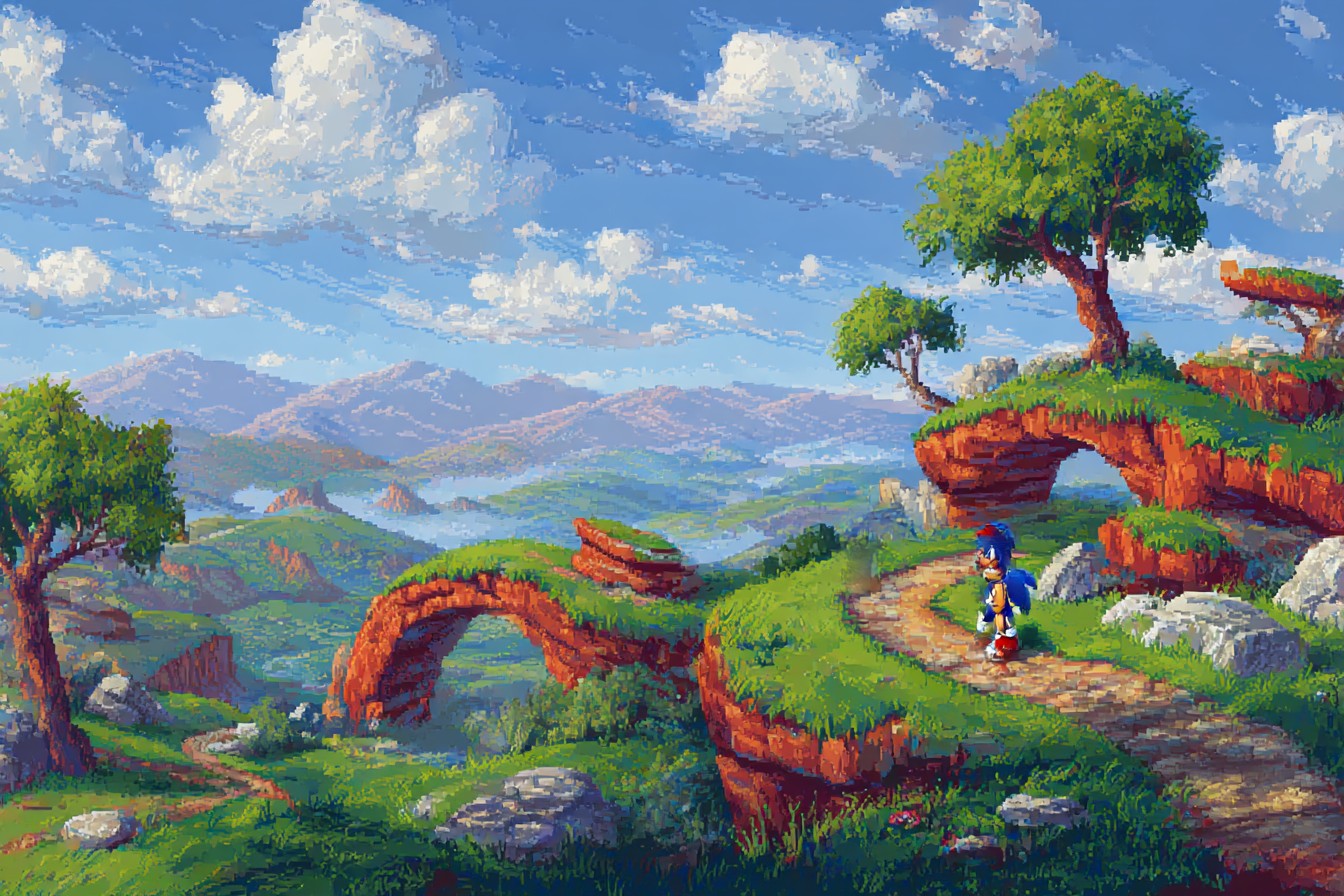
The level design actually holds up remarkably well. Each zone has this lived-in quality that some of the traditional Sonic games lack. Green Grove feels like an actual ecosystem rather than just a themed backdrop with platforms scattered around. Rusty Ruin has this genuine sense of ancient machinery being slowly reclaimed by nature – you can almost feel the history in those crumbling walls and overgrown gears. Diamond Dust, the obligatory ice world, makes the cold feel like an actual gameplay mechanic rather than just a visual gimmick. You can practically feel Sonic’s traction changing on those slippery surfaces.
Playing it now, especially on a good CRT or with proper scanline filters, the visual design aged way better than a lot of early polygon work from the same period. Those pre-rendered sprites have this chunky, tactile quality that still looks appealing. Sonic himself animates with real personality – check out his idle animations, the way he taps his foot impatiently when you leave him standing around. Those little details matter more than you’d think.
Is it the best Sonic game ever made? Absolutely not – that’s still Sonic 3 & Knuckles and anyone who disagrees can fight me. But is it an interesting experiment worth experiencing? Definitely. It’s the kind of game that reminds you why the mid-90s were such a wild, creative time in the industry. Studios were willing to take established franchises and completely twist them into different shapes just to see what would happen. Sometimes you got disasters, sometimes you got classics, and sometimes – like with Sonic 3D Blast – you got something that sits comfortably in between, being quietly excellent at being exactly what it is instead of what people expected it to be.
Mike decided to keep his copy after all that reminiscing, by the way. Said it reminded him why he fell in love with gaming in the first place – not because of the obvious crowd-pleasers, but because of the weird little experiments that had the courage to try something completely different. Sometimes those end up being the most memorable games of all.

Samuel’s been gaming since the Atari 2600 and still thinks 16-bit was the golden age. Between accounting gigs and parenting teens, he keeps the CRTs humming in his Minneapolis basement, writing about cartridge quirks, console wars, and why pixel art never stopped being beautiful.