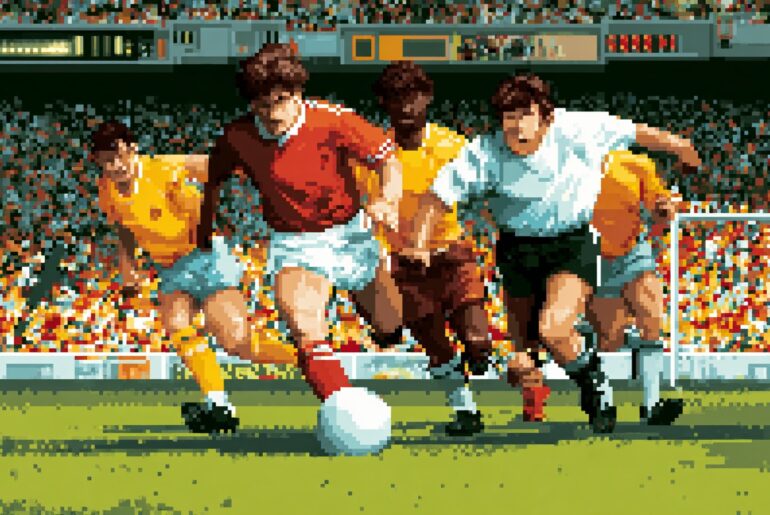
Look, if you grew up in the early 90s and owned an Amiga or Genesis, you already know why Speedball 2 matters. It’s one of those games that absolutely everybody had an opinion on, whether they loved the brutal future sports concept or thought it was too violent for its own good. Tim keeps insisting modern Rocket League captures the same energy, but he’s missing the point entirely. Speedball 2 wasn’t just about futuristic sports, it was about proving that video games could embrace controversy and come out stronger for it.
Released in 1990 (Launchbox GamesDB) for Amiga and Atari ST, then hitting the Mega Drive in December 1991 (Internet Archive), this game arrived during the period when 16-bit systems were hitting their stride. The Bitmap Brothers (Wikipedia) had already established themselves with games like Xenon II, but Speedball 2 was their masterpiece, a perfect fusion of arcade action, strategic depth, and that distinctly British sense of dark humour that made their games special.
| Developer | Bitmap Brothers |
| Publisher | Image Works |
| Release Year | 1990 |
| Platforms | Amiga, Atari ST, Mega Drive, Master System, C64, DOS, Game Boy |
| Players | 1-2 players |
| Our Rating | 9/10 |
Speedball 2 is probably the best sports game ever made, and I’m going to tell you why. It’s one of the few sports games from the 16-bit generation that still feels totally modern, even today. Most 16-bit sports games feel dated by today’s standards, but Speedball 2 doesn’t. The Bitmap Brothers made sure the core mechanics were as strong as possible, and that the game was extremely well-rounded in terms of how it was designed. It earned its place in our broader discussions about the greatest sports games of the 16-bit era, and it’s the perfect example of why that generation produced games that still feel fresh today.
The Game That Made Violence into Sport
The genius of Speedball 2 wasn’t just that it imagined a violent future sport, plenty of games had done that. The brilliance was in how systematically the Bitmap Brothers thought through what that sport would actually look like. Each match runs for exactly 180 seconds (StrategyWiki), which sounds ridiculously short until you play it and realise how perfectly paced those three minutes are.
You control a team of nine players (Launchbox GamesDB) in what’s essentially handball crossed with American football, but with body armour and absolutely no rules about fair play. The objective seems simple enough, get the metal ball into the opposing goal, but the actual gameplay revolves around a scoring system that rewards tactical thinking over pure aggression.
Here’s where Speedball 2 gets clever. Yes, you can score goals, and they’re worth the most points. But you also get points for bouncing the ball off specific targets on the arena walls, for knocking opponents unconscious, and for maintaining possession. The game actively encourages you to think beyond just charging toward the goal. Sometimes the smartest play is to work the ball around the arena, racking up target points whilst wearing down the opposition.
The substitution system adds genuine strategic depth. With three substitutes per team (StrategyWiki), you’re constantly making decisions about when to pull injured players and when to keep them on despite taking damage. Players who take too much punishment move slower and can’t throw as hard, but substituting them means losing their accumulated experience for that match.
League Mode That Actually Mattered
Most sports games in 1990 treated single matches as the main attraction, with league modes feeling like afterthoughts. Speedball 2 flipped that completely. The real game was in the league campaign, where you started with Brutal Deluxe, easily the worst team in the competition, and had to claw your way up through two divisions to eventually challenge the legendary Stamina Boys for supremacy.
This wasn’t just about winning matches. Between games, you could visit the shop to upgrade your players’ abilities, buy better equipment, and even enhance the arena itself. The upgrade system felt meaningful because you could see the direct impact on gameplay. Upgrading a player’s throwing power meant they could score from further out. Better stamina meant they’d stay effective longer. Improved tackling made them more dangerous in defence.
The AI opponents weren’t just palette swaps either. Each team had distinct playing styles that you had to adapt to. Some teams played defensively, parking everyone near their goal and forcing you to work for every point. Others came at you with pure aggression, trying to knock out your players early and overwhelm you through attrition. The most dangerous teams mixed both approaches, switching tactics mid-match to keep you guessing.
What made the league mode genuinely compelling was how it captured that feeling of building something from nothing. You’d start each season knowing your team was rubbish, but by carefully managing upgrades and learning each opponent’s weaknesses, you could gradually transform them into genuine contenders. The satisfaction of finally beating a team that had dominated you earlier in the season never got old.
Graphics and Sound That Defined an Era
The Bitmap Brothers had a house style that was immediately recognisable, and Speedball 2 might be their most polished example of it. The character sprites were chunky and detailed, with enough animation frames to make every action feel weighty. When a player got tackled, you felt the impact. When someone threw the ball, you could see the wind-up and follow-through. This wasn’t just aesthetic, the visual feedback was crucial for understanding exactly what was happening in the organised chaos of each match.
The arena design deserves particular credit. Rather than just creating a bland rectangular field, the Bitmap Brothers built environments that felt like genuine sporting venues. The metallic walls weren’t just boundaries, they were tactical elements covered in scoring targets, bounce pads, and hazards that affected play. The crowd animations and atmospheric details made every match feel like a genuine sporting event rather than just a game of handball with violence.
But the real standout was the music. The Bitmap Brothers always understood that audio could make or break the atmosphere, and Speedball 2’s soundtrack was absolutely perfect. The main theme was this driving, industrial track that got your adrenaline pumping before matches even started. The in-game music maintained that energy without becoming distracting, whilst the crowd noise and impact sounds provided crucial audio cues for what was happening on the pitch.
The sound effects deserve mention too. Every collision, every ball bounce, every successful target hit had its own distinct audio signature. After playing for a while, you could track the action purely by sound, which was essential given how fast-paced matches became.
Why the Genesis Version Became Legendary
Whilst Speedball 2 started life on the Amiga in early 1991 (StrategyWiki), it was the Mega Drive port that really made the game famous. Image Works (Sega Retro) handled the conversion beautifully, maintaining the core gameplay whilst adapting perfectly to the Genesis controller.
The six-button pad was ideal for Speedball 2’s control scheme. You had separate buttons for throwing, tackling, and using special moves, which meant you could execute complex plays without awkward button combinations. The Genesis version also benefited from that console’s excellent sprite handling, all those players moving around simultaneously never caused slowdown, even during the most chaotic moments.
More importantly, the Genesis version arrived at exactly the right time. By late 1991, Genesis owners were hungry for games that showcased what their system could do differently from the SNES. Speedball 2 was pure Genesis material, fast, aggressive, and unapologetically violent in a way that felt perfectly suited to Sega’s attitude.
The game even made it to Japan in June 1992 (PixelatedArcade), though it never achieved the same cultural impact there. Japanese gamers had different expectations for sports games, and Speedball 2’s particular brand of British cynicism didn’t translate as well.
The Game That Predicted Gaming’s Future
Looking back, Speedball 2 was remarkably prescient about where gaming was heading. The emphasis on upgrading players through earned currency? That’s the foundation of modern sports game progression systems. The focus on short, intense matches designed for maximum engagement rather than simulation accuracy? That’s basically the entire mobile gaming playbook.
The violence controversy that surrounded Speedball 2 seems almost quaint now, but at the time it was genuinely divisive. Some critics argued that games shouldn’t glorify brutality, even in a fictional future sports context. Others defended it as harmless fantasy violence no different from action films. The debate helped establish gaming as a medium worth taking seriously, even if the discussions weren’t always productive.
What’s interesting is how well Speedball 2 holds up today, available across numerous platforms (MobyGames) including modern compilations. The core gameplay loop remains completely engaging. The graphics still look fantastic on a proper CRT. The music still gets your blood pumping. It’s one of those rare games that achieved timeless design through focused execution rather than technical innovation.
A Perfect Storm of Design and Timing
The more you think about it, the more remarkable Speedball 2’s success becomes. The Bitmap Brothers created something that worked brilliantly as a single-player experience, held up perfectly in two-player mode, and managed to be simultaneously accessible to newcomers and deep enough for serious competition. They took a concept that could have been just mindless violence and built genuine tactical depth around it.
The game arrived at the perfect moment in gaming history, when 16-bit systems had enough power to realise ambitious design concepts but were still constrained enough to force disciplined creativity. Speedball 2 feels like the product of developers who knew exactly what they wanted to achieve and had the technical chops to execute it flawlessly.
Thirty-plus years later, it remains the definitive example of how to create a fictional sport that feels both believable and engaging. Every attempt to recapture its magic has missed something crucial, usually the perfect balance between accessibility and depth that made the original so special. It’s not just a great sports game or a great action game. It’s a perfect game, full stop.
You know what I mean? Some games just get everything right, and Speedball 2 is absolutely one of them. If you’ve never played it properly, you owe it to yourself to track down the Genesis version and experience what peak 16-bit game design actually looked like.