There I was, fifteen years old with a fresh N64 controller in my hands, expecting another colorful romp through whatever cutesy world Rare had cooked up next. I mean, come on—this was the studio that gave us Banjo-Kazooie and Donkey Kong Country. Fluffy platformers with family-friendly charm, right? Then I booted up Conker's Bad Fur Day for the first time, and honestly? My teenage brain nearly short-circuited.
The opening sequence alone should've prepared me. That cheeky red squirrel stumbling around drunk, slurring his words, complaining about his hangover—this wasn't Diddy Kong's Quest, that's for sure. By the time Conker started hurling profanity at a dung beetle the size of a small car, I knew Rare had completely lost their minds. And I absolutely loved them for it.
See, back in 2001, gaming was still this weird middle ground where most developers played it safe with ratings. You had your Teen games that pushed boundaries just enough to feel edgy, and then you had the occasional Mature title that usually meant blood and violence. But Conker? This little furry bastard went nuclear on every single content warning you could imagine. Graphic violence, sexual themes, crude humor, strong language—the ESRB probably had to create new categories just for this game.
I remember sneaking it past my parents by emphasizing it was made by Rare, the same folks behind all those "nice" games they'd already approved. Little did they know their precious Nintendo system was about to host what was essentially an R-rated Pixar movie disguised as a platformer. The cognitive dissonance was incredible—here's this adorable cartoon squirrel with button eyes and a fluffy tail, casually dropping F-bombs and making jokes about bodily functions that would make a sailor blush.
What really got me wasn't just the shock value, though. Don't get me wrong, hearing video game characters swear like real people for the first time was absolutely mind-blowing. But underneath all that crude humor was some genuinely brilliant game design. Rare took every single platformer trope you'd ever encountered and completely subverted it. The cash collectibles? Literally piles of money. The boss fights? A massive pile of singing excrement, an opera-singing gargoyle with… let's call them anatomical exaggerations, and a xenomorph parody that was somehow more terrifying than the actual Alien films.
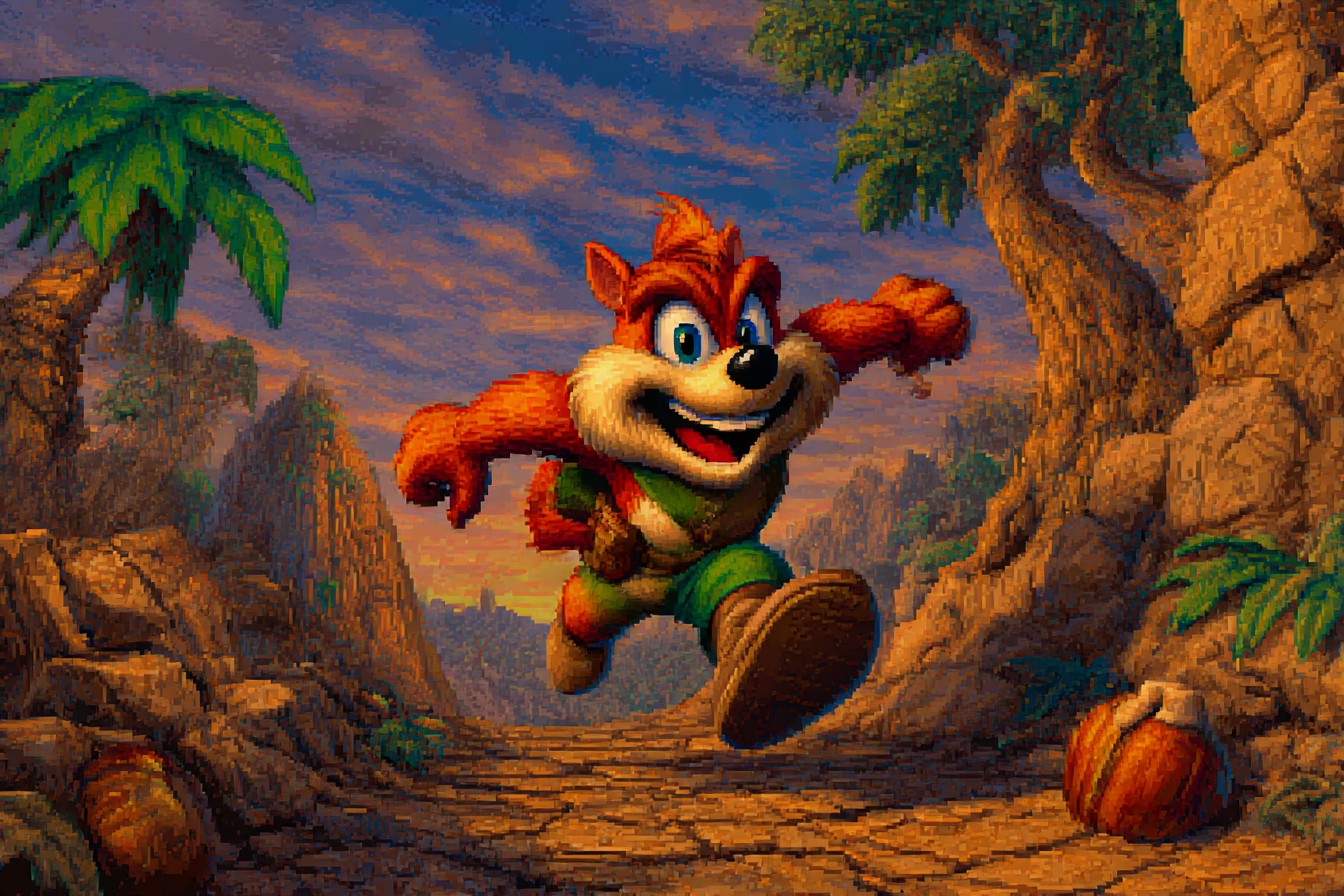
The Great Mighty Poo boss fight still makes me giggle like an idiot. Here's this towering mountain of sewage belting out opera while hurling toilet paper rolls at you, and the whole thing is orchestrated with the kind of production value usually reserved for Disney musicals. The voice acting, the animation, the sheer commitment to the bit—it was simultaneously the dumbest and most sophisticated thing I'd ever seen in a video game.
But what really pushed boundaries wasn't just the content itself—it was how Rare wrapped all this adult humor in the visual language of children's entertainment. The character designs looked like they belonged on Saturday morning cartoons. The world was bright and colorful, full of the kind of whimsical architecture you'd expect from a fairy tale. Yet here's Conker chatting up a sunflower with, uh, feminine attributes, or getting into a drinking contest with a scarecrow. It was like discovering your favorite childhood storybook had a secret R-rated director's cut hidden inside.
I think that's what made it so effective, actually. The juxtaposition was jarring in the best possible way. You'd be bopping along to some cheerful background music, admiring the gorgeous textures and lighting effects that really showed off what the N64 could do, then suddenly you're in a war zone getting machine-gunned by teddy bears while beach balls with swastikas fly overhead. Rare wasn't just pushing the envelope—they were setting it on fire and dancing around the ashes.
The voice acting deserves special mention here. Chris Seavor, who directed the game and voiced Conker himself, gave the character this perfect mix of cheeky British charm and genuine world-weariness. Conker wasn't your typical heroic protagonist—he was selfish, lazy, and often downright mean. But somehow that made him more relatable than any noble prince or plucky animal hero. He felt like a real person trapped in a cartoon world, just trying to get home to his girlfriend while dealing with increasingly absurd obstacles.
And the references! Good lord, the references. Rare stuffed this game with so many movie parodies and pop culture nods that I'm still discovering new ones today. A Clockwork Orange, Saving Private Ryan, The Matrix, Alien—they spoofed everything with this gleeful irreverence that somehow never felt mean-spirited. Even when they were making jokes about the most inappropriate subjects imaginable, there was this underlying warmth to it all.
The multiplayer modes were equally unhinged. Beach volleyball with bikini-clad sunflowers, war scenarios with cute woodland creatures wielding bazookas, racing through obstacle courses while dodging giant boulders—it was like someone took every possible Nintendo party game concept and ran it through a blender with South Park episodes.
Looking back now, I'm amazed Nintendo actually published this thing. The company that built its reputation on family-friendly entertainment gave the green light to a game where the protagonist literally urinates on fire demons to defeat them. That level of creative freedom seems almost impossible to imagine today, when every major publisher has committees and focus groups analyzing every potential controversy.
But that's exactly why Conker's Bad Fur Day remains so special. It proved that mature content in games didn't have to mean generic space marines shooting aliens in brown corridors. You could tackle adult themes with creativity, humor, and genuine artistic vision. The game was simultaneously a celebration of and a middle finger to everything we expected from the medium.
Years later, when Microsoft acquired Rare and we got Conker: Live & Reloaded on the original Xbox, something felt different. Sure, the graphics were prettier and the online multiplayer was expanded, but they'd censored some of the language and toned down certain scenes. The raw, rebellious energy that made the original so special got smoothed over by corporate sensibilities.
That's the thing about true boundary-pushing art—it can't be replicated or sanitized without losing what made it revolutionary in the first place. Conker's Bad Fur Day captured lightning in a bottle during that brief window when a major developer could get away with absolute creative anarchy on a mainstream console.
Even now, two decades later, nothing quite compares to the experience of playing it for the first time. Modern games might have more sophisticated humor or more complex themes, but they're usually playing to audiences that expect that kind of content. Conker blindsided us when we were still expecting every cartoon animal to collect rings and save princesses.
It remains one of gaming's greatest magic tricks—a Trojan horse of subversive entertainment that snuck past every gatekeeper and forever changed what we thought video games could be.