There's something about sitting in front of a telly on a quiet Sunday afternoon, N64 controller in hand, watching a little hang glider drift over Birdman Island that just…gets you, you know? I've been thinking about this lately because I dug out Pilotwings 64 last week—proper cartridge, none of this emulation business—and within minutes I was back in that headspace where time moves like honey and your biggest concern is landing on the correct pad without face-planting into a tree.
Most people remember the N64 for the obvious suspects: Mario 64's revolutionary camera work, GoldenEye's split-screen mayhem, Zelda's lock-on brilliance. Fair enough. But Pilotwings 64? That was Nintendo showing off in a completely different way. No epic quest, no high score to chase, no princess to rescue. Just you, some aircraft, and the quiet satisfaction of mastering flight in a world that felt more like a holiday brochure than a video game.
I picked up my copy from a Blockbuster closing down sale—remember those? Rows of ex-rental games with slightly mangled labels and that particular smell of a thousand hands. The assistant looked at me funny when I grabbed Pilotwings alongside Perfect Dark. "Bit of a change of pace there, mate," he said. He wasn't wrong. Going from Carrington Institute's corridors to Holiday Island's beaches was like switching from espresso to chamomile tea.
The thing that gets me about Pilotwings 64 is how Nintendo understood that not every game needs to spike your heart rate. Sometimes you just want to exist in a space that feels good. Those islands—Holiday Island, Ever-Frost Island, Crescent Island—they weren't just backdrops for your aerial antics. They were postcards you could actually visit, complete with that peculiar N64 fog that somehow made everything feel both infinite and intimate.
Flying the hang glider was pure meditation. I'd launch off Little States Island and just…drift. The wind physics felt authentic in that early 3D way where you could sense the mathematics working underneath, but it never felt clinical. Your glider would catch thermals, dip in downdrafts, respond to those subtle stick movements with the kind of grace that made you forget you were pushing buttons on a three-pronged plastic thing.

The rocket belt, though—now that was a different beast entirely. First time I strapped that thing on virtually, I careened into a cliff face within seconds. The thrust control was twitchy, unforgiving, absolutely nothing like the graceful arcs of hang gliding. But stick with it? Master the delicate dance between thrust and gravity? Pure poetry. I spent hours just hovering over the beach on Holiday Island, watching the waves roll in, feeling properly zen about the whole thing.
My mate Dave used to come round specifically for Pilotwings sessions. Not for GoldenEye death matches or Mario Kart tournaments—he wanted the gyrocopter challenges. He'd sit there, tongue poking out in concentration, trying to nail those ring courses with the precision of a surgeon. "It's like flying a washing machine," he'd mutter, wrestling with the collective controls. But when he'd finally thread that last ring and stick the landing? The grin was worth it.
Nintendo built these aircraft to feel different from each other in ways that went beyond simple cosmetics. The hang glider encouraged patience, reading the environment, working with forces bigger than yourself. The rocket belt demanded absolute control, precise inputs, constant vigilance. The gyrocopter was somewhere in between—powerful enough to muscle through challenges but temperamental enough to punish overconfidence.
Then there was the bonus island. Ah, Little States. Nintendo's cheeky miniaturized America, complete with a tiny Mount Rushmore that you could actually land on if you were mental enough to try. I spent an embarrassing amount of time exploring that place, not because the game demanded it, but because it felt like discovering a secret room in your own house. The attention to detail was barmy—little cities with roads you'd never drive on, landmarks scaled down to doll-house proportions, a whole continent you could cross in about thirty seconds of flying time.
The photographic missions were brilliant too. Nintendo giving you a camera and saying "go document our world" felt revolutionary back in '96. No Pokemon Snap yet, no social media, just you capturing moments in a digital space that felt worth preserving. I've still got save files full of wonky aerial shots—blurry islands, poorly framed landmarks, the occasional accidental selfie when I hit the wrong button.
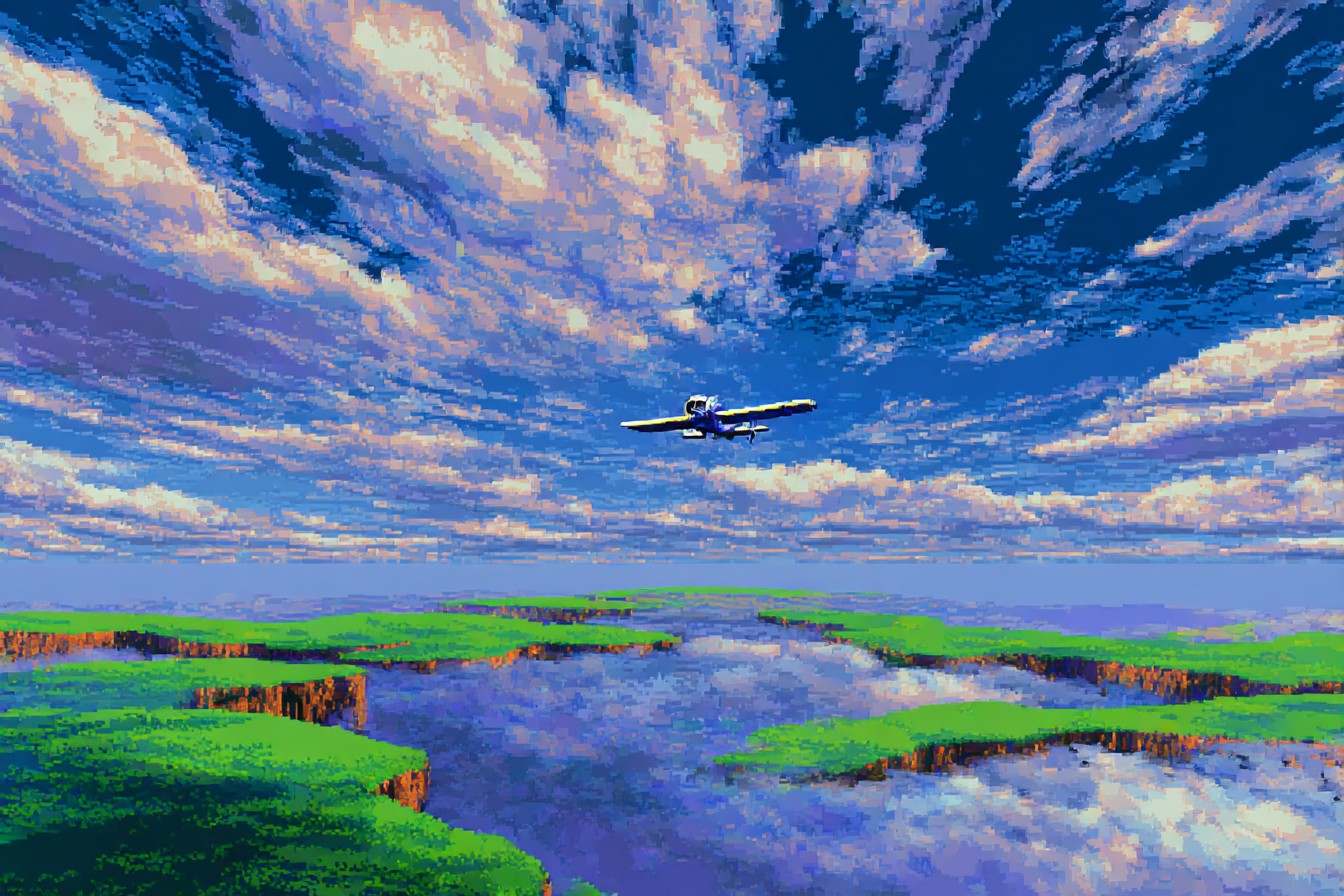
What strikes me now, playing it on the same CRT where I first experienced it, is how confident the whole thing felt. This wasn't a tech demo disguised as a game or a quick cash-in on the N64's launch lineup. Nintendo had crafted something that understood the joy of simply being somewhere beautiful, of mastering skills for their own sake rather than to defeat a final boss or rack up points.
The sound design deserves a proper mention too. That gentle wind rushing past your ears during hang glider runs, the rocket belt's aggressive whoosh, the rhythmic thump of gyrocopter rotors—it all contributed to this sense of actually being airborne. Through tiny TV speakers and basic audio chips, Nintendo convinced your brain you were experiencing weather patterns and altitude changes.
Playing Pilotwings 64 today feels like visiting an old friend who hasn't changed much but somehow seems wiser for staying the same. The graphics have that chunky N64 charm that modern HD makes look simultaneously primitive and eternal. The frame rate still hitches when too much geometry loads in at once. The fog still cuts off distant views with all the subtlety of a curtain drop. None of it matters. The zen is still there, waiting patiently in those polygonal islands.
Sometimes I fire it up just to glide around Holiday Island at sunset, watching those painted textures shift through their simple but effective lighting cycles. No achievements to unlock, no online leaderboards to climb, no DLC to purchase. Just flight, pure and simple, in a world that exists purely to be flown through. That's the real genius of Pilotwings 64—it knew exactly what it was and never tried to be anything else.